Showing posts with label Pakistan. Show all posts

Sunday, 14 July 2019

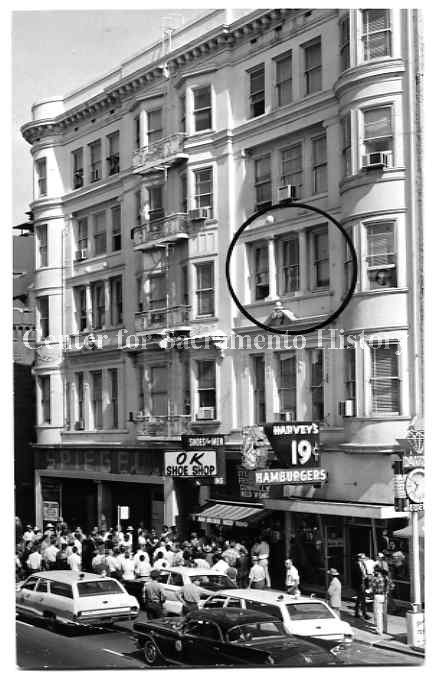
On 25th August in 1966, a Pakhtun Doctor, Aurang Shah, was shot dead by his patient in this building in Sacramento, California. The shooting occurred in the room encircled in the attached photo. So who was this doctor and what is his story?

Dr. Nafees Ur Rehman (Twitter @NafeesRehmanDr)

On 25th August in 1966, a Pakhtun Doctor, Aurang Shah, was shot dead by his patient in this building in Sacramento, California. The shooting occurred in the room encircled in the below photo.

So who was this doctor and what is his story?

Let's have a look at his life and his political activism for Pakhtunistan.

Photo Source: https://sacramento.pastperfectonline.com

Dr. Aurang Shah was born in the village of Manki in Swabi (present day in Khyber Pakhtunkhwa Pakistan) in the family of Rahim Shah Faqirkhel. There is, however, confusion around his Date of Birth. According to Mian Wakil Shah Faqirkhel, he was born in 1890, same year when Bacha Khan was born. But according to findgrave.com, he was born on August 5, 1896.

There is a reason for highlighting this inconsistency in his DOB. Acc. to Mian Wakil Shah's write-up published on the Afghan Express Blog (https://afghanexpress.wordpress.com/), Aurang Shah was offered job as a Tehsildar by the D.C Peshawar as soon as he did his matriculation in 1905. While according to the book The Joffrey Ballet: Robert Joffrey and the Making of an American Dance Company, Aurang Shah and his brother Daulat Khan both attended Bacha Khan's school. Please note that the first school that Bacha Khan had opened in 1910 was in a mosque and it was shut down by the British in 1915. So I wonder if British offered jobs to the graduates (if there were any graduates in the first place in the 5 years of school operation) of Bacha Khan's school.


On the other hand, the book The Joffrey Ballet: Robert Joffrey and the Making of an American Dance Company published 1997, contains interviews of Dr. Aurang shah's son, Naim Shah and his cousins, adding more credibility to the book's take on the subject of schooling.


But lets leave this topic here and discuss Dr. Aurang Shah's journey to the US, his education and his political struggles for Pashtunistan. Aurang Shah and his brother Daulat Khan were encouraged by their mother to go to the US for further education. Their father had earlier been murdered owing to a feud, possibly a family feud. 

So in 1916, they boarded a freighter to the US. Below is the account of their journey.


Both brothers had lived their american dream. They started off with selling food on pushcarts with their own original recipe of chili that earned them big bucks later. With that money, they parted ways and pursued different careers.


Daulat opened a restaurant in Seattle while Aurang Shah did his MA from Harvard and then obtained a medial degree from the Tufts - achieving the goals that he & his mother had setup for him. Even after success, the two brothers always carried the chili recipe in their wallets.


Aurang Shah was always politically active and founded Azad Pakhtunistan Association of America in 1928 in California and with this he also founded the idea of an independent Pashtunistan/Pakhtunistan. According to Mian Wakil Shah, Dr. Aurang would send funds to Bacha Khan to support his political agenda. Its worth-noting that Bacha Khan was against the partition of India meaning he wasn't for an independent Pakhtunistan, at least not until the partition was agreed upon.

According to a recent PhD study[1], Aurang Shah's political activism was sparked after creation of Pakistan when Bacha Khan got arrested. This contradicts the account presented by Mian Wakil Faqirkhel that Dr. Aurang Shah was actively pursuing the idea of Pashtunistan since 1928.


Mian Wakil Shah didn't provide any references and sources in support of this claim neither have I been able to find them. On the other hand, there is a lot of evidence that points to Dr. Aurang Shah political acivitism post Pakistan's creation.

For example, the pro-Pashtunistan protest in 1950 in California when Pakistani premier, Liaquat Ali Khan visited USA.

Kabul, Number 267, Volume 20, Issue 7, June 22, 1950; Kabul Afghanistan.


And the letters that he wrote to the editor in the Sacramento Bee [1] protesting the arrest of Bacha Khan in Pakistan, and US refusal to issue visa to Bacha khan in 1956 and 1965.


This shall give a better picture of Dr. Aurang Shah's activism for Pashtunistan supported by Afghanistan.

Afghanistan awarded him the 2nd highest civil award for his activism.


However, as we all know, the idea of Pashtunistan never materialized owing to the fact that there was not enough public and political support behind it.


On 25th of August, 1966 when he was in his clinic, a disgruntled patient named Lovato shot him dead with a pistol. According to his will, he was buried in Kabul and his funeral was also attended by king Zahir Shah of Afghanistan and Khan Abdul Ghaffar Khan aka Bacha Khan.


Bibliography:

1. Baden, J. (2018). Through Disconnection and Revival: Afghan American Relations with Afghanistan, 1890-2016. (Electronic Thesis or Dissertation). Retrieved from https://etd.ohiolink.edu/
2. Anawalt, S. (1998). The Joffrey Ballet: Robert Joffrey and the making of an American dance company. University of Chicago Press.
3. Kabul, Number 267, Volume 20, Issue 7, June 22, 1950; Kabul Afghanistan.
4. Sacramento Archives, URL https://sacramento.pastperfectonline.com/, accessed July 8, 2019.
5. FindAGrave.com, (URL: https://www.findagrave.com/memorial/128232028/aurang-shah), accessed July 8, 2019.
6. Article د پښتونستان د تصور ګمنام خالق, Mian Wakil Shah Faqirkhel (URL https://afghanexpress.wordpress.com/) accessed July 8, 2019.

Monday, 3 October 2016

QK Archives: Da Kabul Naukari...

The Frontier Post, July 1989

By Shahid Orakzai

“Hey buddy, how about a job at Kabul?”, the bandarwala would ask the monkey in the course of his public interview. The rhesus would shriek and jerk his head in strong disapproval and audience would burst into laughter. By the late 1920s, even monkeys roaming the dusty streets of Peshawar had picked up that much common sense. “Da Kabaul naukari na kawam,” (“employment in Kabul-Oh never”) had become a popular Pashto expression that echoed in the hills of the Khyber and rang through the valleys of the Pathan country. A job at Kabul, most probably recruitment in the ill-clad Afghan infantry, was not worth a monkey who happened to live east of Durand Line.

That was the time when the times actually started changing for the Pukhtoons on the two sides of the British drawn demarcation. Apparently, they had only two options. Either stay loyal to an impotent and bankrupt monarchy in Kabul or do business with flourishing British imperialism in India. There were very few floor crossings and people generally settled for whatever was available on their side of the Line. On average, it appears that Pukhtoons were sold out on a “As is where is” basis.

Some may now cite the hatred for monarchy as one of the reasons but the reason that worked and outweighed all others was the silver coin of the British India. The rupee, today the most authentic and popular measure of a Pukhtoon’s life and achievement, was to be found east of Durand Line. Military service in the Indian Army, earthwork labor, firewood, shoe-shine, transportation, smuggling and narcotics helped the Pukhtoons to discover the new frontiers of the worldly success beyond the banks of ‘Abaasin’ (the Indus). Like a typical watchman, Pukhtoons have watched everyone’s interest but their own.

The British initiated the phenomenon and did everything possible to make sure that the original Pukhtoon culture and values get drained out as fast as possible. The leftover residue of Pukhtoon nation, the way it lies before us today, could then be easily managed. For that objective, the British cultivated two classes in particular, i.e. the Maliks among the hill tribes and feudal politicians in the Charsadda and Mardan. The raj used them like the knife and fork to tear the Pukhtoon nation into pieces. North of the Khyber, Pukhtoons were fast asleep for decades and south of Torkham they were awake only to pocket economic gains. Today, on both sides of the Durand Line, they are a people without a vision of nationhood, sovereignty and even individual honor that once turned clay into a Pukhtoon.

The departure of the British did not prove to be a departure from colonial approach and policies. The knife and fork just changed hands. In fact, they went into hands that could mishandle the tools. Pakistan’s colonial establishment inherited the British visions and outlook and viewed the geo-political realities no differently. The reunion of the divided Pukhtoons could never fit in its scheme or frame of mind. That possibility could be perceived only as a threat. Consequently, Pakistan’s political and military leadership moved to counter that threat instead of capitalizing the idea.

After 1947, the Pukhtoons secured a reasonable share in the economic fortunes. Their lower and middle classes began to move around freely in the agriculturally rich plains of Punjab and Sindh in a variety of economic pursuits. Consequently, their social and economic bonds with Punjabis grew stronger with time while their blood bond with the people northwest of the Khyber began to liquidate. A bit of economic prosperity and political freedom injected a strange superiority complex among Pakistani Pukhtoons. They began looking at their own Afghan brethren as inferiors- in every sense of the world. During the last few decades, the economic pace at the two ends of the Khyber Pass drew another Durand Line. That’s what anyone seeking to divide a nation could eventually desire. The Establishment had always worked in that direction, patting the Pukhtoons and telling them, “you are much better off with us than you could be with Kabul.” Allow me to recall the comments of a Sindhi Prime Minister, as he addressed an audience of Maliks at my hilltop village. The most enlightened premier Pakistan ever had ordered his minister for power and resources to fix big tungsten bulbs on the Afghan border “so that they (the Afghans) can see the light on our side and feel the darkness on their’s.” If electric bulb is all the light that nations need to get enlightened, one wonders who is the dark?

As an Islamic Republic, Pakistan had always turned its back to the miserable state of Iranian and Afghan people. The champions of the freedom and liberty never challenged the policy that consolidated despotism in our western neighborhood. While the Muslims of the Pakistan wanted freedom and civil rights for themselves, they preferred to see others in chains. Turning a deaf ear to the advice of Prophet Muhammad-“Do not prefer for your brother, what you don’t like for yourself,” they set a new standard for Islamic brotherhood. The new motto is, “Support the kings, wherever you find them.”

The indifference towards the Persians and Afghans had a penalty. The penalty is being paid in the capitalist havens of the Karachi. And that’s quite natural and well deserved. If you don’t accept the blood bond between the Pukhtoons on the two sides of the Durand Line, how valid is the bond between the Pukhtoons and the Punjabis or Punjabis and Sindhis, the Sindhis and Muhajirs, Muhajirs and Punjabis. Name a single one of these relationships that is stronger than the bond between the divided Pukhtoons. What does a Pukhtoon share with a Sindhi that he does not share with his own tribesmen across Torkham?  Religion?  Language? Philosophy? Or separatism?


Employment in Kabul is still out of question for a Pukhtoon east of Khyber but his rejection this time shouldn’t be based on poor salary, provident fund and pension. A job at Kabul is still worth a monkey and Moscow has found the monkeys it needs. Informatively for the Pukhtoons, it is willing to pay them more than the British once offered.

Saturday, 25 August 2012

Picture of the day: Karachi

Warning Notice Keamari: "South African Europeans would not be welcome to Karachi (1946) in view of the racial discrimination made in their country and the anti Indian legislation passed by them". picture courtesy Ali Jan

Tuesday, 7 August 2012

My Hero: Safwat Ghayur

Postcard from Delhi: Aneela Babar tells her child the story of her hero Safwat Ghayur 


by Aneela Z. Babar

Dear Child,


Three days into the month had me waking up one night in tears. A long time believer in signs and dreams I spent some time calling up your father cautioning him to be careful in the coming days. I was still not restful and woke you up a couple of times in the night as I paced about the room, praying for mercy. In my selfishness I feared the Purvey of the Horrors To Come to visit only my boys. I never imagined that my sister of the heart who as a child would finish that offensive mug of milk for me would now put her lips to the poisoned cup of pain for us as well. I am glad we were here in Pakistan for this my son, and that at some level you  too absorbed some semblance of what service to the nation beyond the call of duty means. That you could register the different colours of love, of valor, of courage, of facing pain with dignity. You were in the presence of a very brave woman that was generous with her compassion and patience. At a time when I raged and ranted (the tears were yet to come) it was only the touch of her cool hand in mine that reminded me how very blessed I am to have her and hers in my life. In the years to come you will hear many stories of a very brave man who smiled his ways into all our lives. He was our hero, now he will be yours. His story is not over, he was a most unusual person for our times and our world, I wait to see how the next chapter unfolds.

 Sarfaroshi ki tamanna ab hamaare dil mein hai.
Dekhna hai zor kitna baazuay qaatil mein hai
Karta nahin kyun doosra kuch baat cheet,
                             Dekhta hun main jise voh chup teri mehfil mein hai 
Aye shaheed-e-mulk-o-millat main tere oopar nisaar,
Ab teri himmat ka charcha ghair ki mehfil mein hai
Sarfaroshi ki tamanna ab hamaare dil mein hai.


 The desire for sacrifice is now in our hearts
We shall now see what strength there is in the boughs of the enemy.
O country, Why does no other speak?
Whoever I see, is gathered quiet in your party...
O martyr of country, of nation, I submit myself to thee
For yet even the unacquainted speaks of thy courage
The desire for struggle is in our hearts
We shall now see what strength there is in the boughs of the enemies.
When the time comes, we shall show thee, O heaven
For why should we tell thee now, what lurks in our hearts? 


Though I could have also played around with another famous dialogue from the film


Safwat Ghayur ke dushman ka sirf ek hi kasoor hai ......ki woh Safwat ka dushman hai! ...

    You can charge Safwat's enemy of but one crime...that he is Safwat's enemy

but you get the gist:
(July 14, 1959 – August 4, 2010) 

But going back to the enigmatic Mr Ghayur. Yes, I don’t think his fan group was remiss in placing him on a pedestal, not for him the human vices of sloth, pride, vulgarity, boorish behaviour or pettiness and laziness as someone who was born to such good fortune as him could have succumbed to—somehow this suave French speaking, globetrotting, head strong, incorruptible law enforcer reminded you of the heroes from popular cinema who would battle baddies, dodge bullets, with not a crease in their well stitched suit – and here I am leaning towards a certain Secret Service Agent and not the Jat, for our hero preferred to deliver his killer lines at a lower decibel. 


Interesting aside: Mr Ghayur has been to the local cinemas, well at least for one Pushto movie when he chaperoned a visiting friend. The said friend was pretty scandalized with our domestic fare and declared it made French erotica seem like a training manual by the Taleban for virtuous behaviour (or words to that effect). But I guess this excursion of his, gives us just cause to add the line “he was a patron of the local arts” to his resume, lest he sounds too pucca saheb for you.

Yes, yes nothing got to our debonair man in uniform, not battling the thugs, nor sweating out in the thanas, and the various encounters he found himself in--- or made sure that he made a detour to “find" himself in. Yes, not even the most hair raising adventure of all --that has people tearing out their hair ,  running out of the house in their pyjamas. Raising two under-twos!! Yup, he did that too. Unfazed, and as quite the dapper gentleman.


I first encountered this gentleman as the paramapada of an elaborate game of snakes and ladders a very charming young woman outlined on the dining table for her elder sister. That the young woman went on to marry the hero of our tale is- well -another story. She is a bit vague with the details, but how fortuitous for someone who answered  a "police officer" (when asked what she wanted to be when she grew up), to marry one when she ended up  in medical school instead.

But the same person who introduced us to Hotel California, played Everyone Loves Kung fu Fighting in a band in Bangkok. He had friends who set up restaurants in Islamabad THAT WERE OPEN AT 9 pm (which was really cool for a city where you walked on the wild side if you spoke to someone in a different BPS grade than you),  who drove off with his new bride in a car come rukhsati time, and a very nice car I should add! ALONE! gasp!(with no sisters, cousins, and the ubiquitous five year old niece who will tug at the bride’s veil for the entire journey) in the process scandalizing all the old aunts and well the not so old amongst us as well.

He was also the good son who abandoned a really good first job offer (yes teaching karate is a pretty fine job) to accompany his family back to Pakistan, who might have dreamed of joining the foreign service (and would have been very good at it ) but chose instead the police so he could be around when his family needed him –and in turn took care of a family far far larger than his own. Ok, fine! maybe, we should go ahead and call him the desi hero after all!

I don’t think I am the stage in my life when I can find meaning in the things that happen to our heroes—but I do find comfort and a lot of laughter in the image of the foolish young man who goes up there believing himself to be a martyr with all the 70 houris and rivers of milk and honey it brings and encounters Safwat Ghayur instead. 

Yes, perhaps there is some divine justice after all...

Aneela Z. Babar (Pindi/Delhi/Melbourne). When she is not busy being the bane of her three year old's existence, Babar works on gender, culture, religion and militarism (with a heady dose of Bollywood trivia).


ed note: some months ago, a man was stopped by the police at a crossing in Peshawar. ' Why can't I pass?' Sorry Sir he replied his boss was passing, his boss you see was a brave man you see and the target of the Taliban. 'A brave man? You only had one brave boss his name was Safwat Ghayur and he is dead!'
RIP Safwat Ghayur and all those who have fought the good fight

Tuesday, 31 July 2012

Wali Khan : The Frontier Liberal


by  M. Taqi

part 1 of a five part profile series written over the last two years by the writer


گریزد از صف ما ہر کہ مرد غوغا نیست
کسے کہ کشتہ نہ شد از قبیلہ ما نیست
guraizad az saf e ma har keh mard e ghaugha neest
kasay keh kushtah na shud az qabeela e ma neest


He who lacks the will to protest, should step away from my fold. Anyone not willing to sacrifice does not belong to my clan -  Nazeeri Nishaburi.

Throughout the second half of the twentieth century Wali Khan indeed remained the voice of protest and democratic opposition in Pakistan.
One is tempted to compare Wali Khan's legacy to the mystical story in Rumi's Mathnawi, of the elephant surrounded by several men in a dark room trying to figure it out. He certainly was different things to different people.
For his adversaries like the right-wing Muslim Leaguers a la Qayyum Khan or the populist ZA Bhutto he was the arch-enemy - an absolute traitor - who should have been physically eliminated. And to this end they tried their best - at times using the services of a certain leftist group in the NWFP.
His adversaries at least concurred on him being a constant thorn in their side. However, his admirers faced a bigger dilemma - how to classify Wali Khan and which aspects of his thought and politics to choose,subscribe to and admire.
Was a he a Pashtun nationalist, out to undo the wrongs of history and colonialism and reunite the Pashtun irredentas of Afghanistan,FATA, NWFP and Baluchistan and recreate a greater Pashtunistan - something that had not been achieved since Ahmed Shah Durrani.
The others argued that he was a socialist in the Nehruvian mould, who relished his role in the Afro-Asian Solidarity movement. And yet others believed that the Solidarity was a front for a complete implementation of the Soviet agenda and Wali Khan was somehow keen on carrying the latter out.
Like the people around the elephant in that dark room, in Rumi's parable, most of us - supporters and detractors alike - only felt parts of Wali Khan's political being and mistook that part for the whole. Such differences in vantage points and observations made therefrom , make Wali Khan's legacy infinitely negotiable.
For example, the late Jauhar Mir - a PPP intellectual and poet- writing about Wali Khan had stated that Wali Khan really had no political creed of his own and he borrowed and adopted the leftist ideology from his fellow travelers.
On the other hand, his comrade-in-arms Habib Jalib opened his poem about Wali Khan with :
مرے کارواں میں شامل کوئی کم نظر نہیں ہے
جو نہ مٹ سکے وطن پر میرا ہمسفر نہیں ہے
meray karwaaN meiN shamil koee kamnazar naheeN hai
jo na mit sakay watan per mera hamsafar naheeN hai
There is no one in my entourage whose creed is pettiness. No such person travels with me who can't make a sacrifice for the motherland
Jalib was visiting Peshawar in 1990 to address election rallies when I asked him about his inspiration for this particular poem about Wali Khan. He acknowledged that indeed it was the Nazeeri Nishaburi's verse quoted in the opening which he had paraphrased.
While the contemporary historians and his biographers - of whom there is a dire need - would certainly keep negotiating and determining Wali Khan's political legacy, one thing is clear that he was a pioneer in the center-left electoral politics in the undivided Pakistan.
Wali Khan's most underestimated contribution perhaps is that he made a clean break with the politics of street agitation espoused by Maulana Hameed Bhashani and the militant adventurism championed by Major (R) Ishaq and Muhammad Afzal Bangash.
The Peshawar declaration of July 1, 1968 announcing the formation of Pakistan National Awami Party (NAP) with a clear electoral program and a socialist economic manifesto was a watershed event in the history of the leftist electoral politics in Pakistan. Along with Professor Muzzafar Ahmed , Mahmud ul Haq Usmani, Arbab Sikander Khalil and G B Bizenjo, Wali Khan had brought the leftists and nationalists not just together but at the verge of political power through ballot.
Another landmark achievement of Wali Khan was using the anti-Ayub campaigns of the 1960s to help the Pashtun polity metamorphose into the twentieth century political party organization. While Baacha Khan's anti-British struggle had trickled down to the town and village level, the organization of the Red Shirts had remained arrested at a pre-independence stage. Wali Khan was acutely aware of this shortcoming and deployed the anti-Ayub campaign's scaffolding to build the NAP's organizational structure along modern lines.
Wali Khan's campaign in support of Ms.Fatima Jinnah against Ayub Khan, not only reflected his anti-tyranny character but in doing so resonated well with the Pashtun youth by then entering the universities and getting exposed to the modern thought. Some of these students like Latif Afridi and Afrasiab Khattak were to later inherit Wali Khan's political mantle at different levels.
Yusuf Lodhi cartoon 
Wali Khan's foremost acknowledged contribution remains his role in the post-1971 constitution making. It was at this juncture that he shone as a polished Westminster style democrat and negotiated and delivered with Z A Bhutto the unanimously approved 1973 Constitution of Pakistan.    
While the PPP's tactics of political intrigue and personal and political persecution threatened to derail the process every step of the way, Wali Khan and other NAP leaders remained above personal fray and pettiness. Former PPP Law Minister Rafi Raza and Sardar Sherbaz Khan Mazari's written accounts are succinct portraits of the magnanimity displayed by the opposition leaders in bringing the constitution-making to fruition.
I am not sure if he would have liked to be called one, but in his words and actions Wali Khan was the liberal in the western sense of the word.
Without subscribing to any textbook ideology, Wali Khan groomed the diversity of political visions he had managed to rally around him. He was bridge between the anti-British struggle and the needs of conducting politics in a modern nation-state. While keeping his values and historical inheritance intact he looked forward to a changing world.In a country teeming with overt religiosity, he had remained a torchbearer of secular ethos till the very end.
I believe that Wali Khan's politics will continue to be studied,admired and criticized from various ideological,political and personal perspectives but I hope that due attention would also be paid to Wali Khan the man. The man who once acted on the stage as a child-star, who was a repertoire of poetry -whether Pashto tapay or Faiz's Urdu ghazals, who loved Yousuf Lodhi's political cartoons and Gulzar Alam's music.
Like Rumi himself, Wali Khan's creed was not the moral certitude but an acknowledgment that an alternative view existed too. This, to me, was the hallmark of the Frontier Liberal that Wali Khan was.
The writer can be reached at mazdaki@me.com. He tweets at http://twitter.com/mazdaki
  • The article originally appeared in "The Statesman" on January 25, 2010.
  •  copyright Statesman, Peshawar republished for information purposes

Thursday, 28 June 2012

Denigerating the Hazaras - I

by Dr. Mohammad Taqi

The post-1978 ethno-national revival of the Hazaras has been a subject of serious scholarship, which apparently Mr Marri is unaware of An article titled “Balochistan: sectarian strife or Hazara community targeted?” written by Mr Surat Khan Marri appeared in these pages this past weekend. The piece is not just an extremely callous one but is littered with factual inaccuracies too. Given the prevailing situation in Balochistan and the important position of Quetta, where most of the Pakistani Hazara community resides, it is pertinent to set the record straight. Mr Marri starts with a not-so-subtle attack on the ethnic origins and the social and political status of the Hazaras in Afghanistan. He wrote, “The Hazara community may claim to be descendants of the Great Khan of the Mongols or a remnant of the Mughals/Mongol conquerors of India via Afghanistan. However, in their recent abode, Afghanistan, they are considered and treated as of low-caste, compelled to work as sweepers and clean latrines, like some Christians in Pakistan and Harijans in India. In Afghanistan, they are in a considerable number, maybe half a million, but in Afghan challenges or wars against the British, Russians, the recent resistance termed as the war on terror, American and NATO aggression, the Hazara community in Afghanistan has no role. Afghans blame them for collaboration with the US and Pakistan.” I find Mr Marri’s slur no different than, and perhaps picked from, 14-pages that the Afghan Gazetteer had dedicated to the Hazaras or Mountstuart Elphinstone’s 1815 drivel against the Hazaras. It is well known that Elphinstone never went beyond Peshawar, and even there, he stayed about four months and gathered information from people who had been fighting the Hazaras for ages. 

There is no hiding the fact the Hazara of central Afghanistan have historically remained at odds with the Pashtun dynasties of Afghanistan and faced extermination at the hands of the latter. Persecuted communities and especially those forced into internal and external displacement doing hard labour — I would not even call it menial or odd jobs — is not an uncommon phenomenon around the world. But Mr Marri has thrown the epithet to rule out a political role for the Hazaras in Afghanistan, and by extension in Pakistan, as he states later. 

On the eve of the 1978 Saur Revolution in Afghanistan, the Hazaras, like most other Afghans, were active on both sides of the political divide. They were a part of the Marxist movement in the 1960s, especially in the Parcham faction of the People’s Democratic Party of Afghanistan (PDPA). Affiliation with the Parcham earned them the wrath of the Khalq faction, which imprisoned thousands of Parchamis during the intra-party feuds of 1978. With the rise of the Parcham leaders Babrak Karmal, and then Dr Najibullah to power, the Hazara leaders like Dr Sultan Ali Kishtmand and the brothers Syed Nasir Nadiri and Syed Mansur were restored to power. Dr. Kishtmand remained the prime minister of Afghanistan until parting ways with the PDPA in 1991. Syed Mansur’s forces in Shiberghan and Baghlan had the status of the official PDPA government militia. On the opposite end of the spectrum, the rural Hazara uprisings against the PDPA started as early as 1979, e.g. in Waras and Yakaolang and led to the formation of Shura-e-Inquilab-e-Ittifaq-e-Islami and its various reincarnations, including an eight-party Mujahedeen alliance, and then the Hizb-e-Wahdat party of Abdul Ali Mazari and Karim Khalili (currently the second vice president of Afghanistan). 

The post-1978 ethno-national revival of the Hazaras has been a subject of serious scholarship, which apparently Mr Marri is unaware of. Another allegation Mr. Marri has leveled is that the Quetta Hazaras somehow exploited the local Baloch welcome – he fails to mention the dominant Pashtuns as the host population – and switched loyalties first to the British and then to the succeeding state of Pakistan. He says:” On their migration to Balochistan, they enjoyed and felt comfortable living in a Baloch liberal and heterogeneous society. However, they soon realized that power and the future lay somewhere else. They allied themselves with British employers and camp followers and had friendly relations with local Baloch-Pashtun collaborators.” Mr. Marri alleges that the Hazaras of Quetta found new patrons in the new Pakistan Punjabi/Urdu speaking elite and somehow were given more than their due share in government services, especially the armed forces. This assertion ignores the fact along with Hazaras like Qazi Issa, Pashtuns like Nawab Muhammad Khan Jogezai and Baloch like Nawab Akbar Khan Bugti Shaheed had also embraced the new power players like Mr. MA Jinnah – the same “Karachiite” that Mr. Marri castigates elsewhere in the piece.

Mr Marri then writes, “Because of their (Hazara’s) allegiance to the new power, the rulers were of the opinion that this minority may replace and fill the vacuum created by the departure of the British army Gurkhas. The Pakistan army started recruiting a large number of Balochistan-based Hazaras, some of whom rose to the rank of general — General Musa being one example; brigadiers (Brigadier Sharbat), and other high ranks.” Sharbat Ali Changezi was a Hazara but not a brigadier. I know this because his children were my schoolmates in Pakistan Air Force School, Peshawar in the 1970s/80s. Air Marshal Changezi served multiple tours of duty at Peshawar at the PAF base and then the Air Headquarters. Out of the two servicemen, Mr. Marri names to make his case, he is wrong about both. Even his spiel about Hazaras being a replacement for the Gurkhas is a farfetched one. The British had formed a Hazara Pioneers regiment but it was already disbanded by 1933.

 One will be hard pressed to find names other than General Musa and AM Sharbat Changezi in the top tiers of the Pakistani armed forces. Officers like General Musa were absorbed into the Frontier Force regiment and no Hazara ‘Gurkha’ regiment ever existed in Pakistan. Mr Marri’s claim that made the lead was, “When General Musa became the governor of West Pakistan, he declared the Hazaras a local tribe of Balochistan through an ordinance.” This assertion needs vetting as the Political Agent Quetta-Pishin issued the final notification declaring Hazaras and three other Afghan tribes, viz Durrani, Yusafzai and Ghilzai, as local/indigenous tribesmen of Quetta on June 22, 1962. The notification refers to two letters dated February 19, 1962 and May 10, 1962 from the Ministry of States and Frontier Regions. The dates put Nawab Amir Muhammad Khan of Kalabagh as the governor West Pakistan and General Musa as army chief, not governor. Regardless, it is the xenophobic and sectarian undertones of Mr Marri’s article that are of primary concern in the evolving situation in Balochistan. (To be concluded)
The writer can be reached at mazdaki@me.com and he tweets at http://twitter.com/mazdaki