|
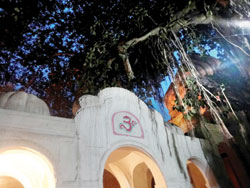
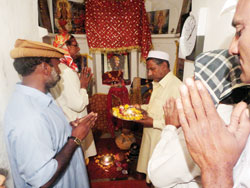
| Advocate Khurshid Khan offers prayers at the Jamia Masjid, Chandigarh, during his visit to India; (right) Polishing shoes at a gurdwara; photo: TOI |
“I wanted to tell the world that I am a Pakhtun, I am a Muslim, I am a Pakistani but I am not a terrorist. I want to tell the people that what they hear about Muslims and Pakhtuns is not true” - Khurshid Khan, Deputy Attorney General, Pakistan
Peshawar-based advocate Khurshid Khan thinks of himself as a “fundamental Muslim”. And he is proud to be one who has polished shoes, swept floors and washed crockery at worship places of Hindus, Sikhs and Muslims, from Peshawar to the Indian Punjab. His aim? To promote interfaith harmony and bridge the gap between the people of Pakistan and India, and to tell the world that Muslims, and Pakhtuns, are peace-loving people who are not terrorists.
When sixty-two year old Khan, who represents the federal government at the Peshawar High Court as Deputy to the Attorney General of Pakistan, recently visited several cities in India, the chief minister of in East Punjab Parkash Singh Badal received him as a state guest. Khan visited worship places of Hindu, Sikh and Muslim communities in Chandigarh, Jaipur, Delhi, Amritsar and other cities to convey a special message of love to the people of India from the Muslim and Pakhtun community of Khyber Pakhtunkha.
He conveyed his message not just through words and prayers, but also by performing the humblest, lowliest tasks. He swept the floor at the Jamia Masjid in Chandigarh and Delhi, and did sevadari (service) with menial chores at the Golden Temple in Amritsar, the Birla Temple in New Delhi, Durgiana Temple in Chandigarh and Seesganj in Delhi. Many were caught by surprise when they learnt that Khan is not only a Muslim but has come from across the border to serve these holy places.
“I washed floors, polished the shoes of those coming for prayers and worked in the kitchen washing dishes and doing other jobs. My purpose in doing all this is to tell the world that Pakhtuns and Muslims are not terrorists,” Khurshid Khan, a former chairman of the students union of the University of Peshawar, told Aman ki Aasha at his modest University Town, Peshawar residence, shortly after his return from 11-day visit to India. The senior lawyer-cum-politician from Peshawar said he was touched by how people in different cities of India received him. “The way I was accorded such a warm welcome and given respect and love is unexplainable. I discovered that the Indian people love us a lot and the same is the case with the people of Pakistan.”
Khan has now sent gifts of Peshawari chappals (sandals) to some of his new friends in India. “I met an octogenarian who owned a huge building in Peshawar’s Rampura Bazaar before he left for India several decades back. I loved his reply in Hindko ‘Landay kee haal aey’ (young man how are you), when I called him Lalay, a word we use for elders in Hindko.”
Khan said that several other people also narrated their memories of living in Peshawar and other parts of the Pakistan before the partition. The senior lawyer was prompted to start his sevadari after the kidnapping of three Sikhs from Peshawar in February 2010. One of the kidnapped men, Jaspal Singh, was killed while army managed to rescue the other two. Around 3,000 Sikhs have been residing peacefully in Peshawar for hundreds of years. Thousands of others live in the southern parts of the province as well as in the tribal areas.
Wanting to express his solidarity with the Sikh community, Khan began going to the Sikh gurdwara in Peshawar’s Dabgari Bazaar. “I used to go and sit silently in a corner. The people coming to worship there were initially suspicious of me,” recalled Khan.
However, they soon realised that the lawyer’s intentions were only to express his sympathies with them.
“I told them that I don’t have any agenda but to serve them. So I was allowed to take the shoes of those coming for worship, polish them and place them in a rack,” said Khan who wore a yellow piece of cloth on his head, like the Sikhs coming to pray. “I wanted to tell the world that I am a Pakhtun, I am a Muslim, I am a Pakistani but I am not a terrorist. I want to tell the people that what they hear about Muslims and Pakhtuns is not true.”
Encouraged by the response, Khan started visiting a Hindu temple in Peshawar’s Karimpura Bazaar, and then a church in Peshawar’s cantonment, adding to his list of places to serve. He has visited the Gurdwara Panja Sahab in Hassanabdal several times, serving thousands of Sikh pilgrims coming from all over the world.
“I’ve also served at a number of mosques in Peshawar and Mardan. I did the same services in the main mosques of Delhi and Chandigarh,” said Khan. He is also looking to visit the Buddhist holy sites in Sri Lanka.
“The one thing I want to do now is to visit the United States on the coming 9/11, arrange services at the ground zero (the site where the twin-towers of the World Trade Center were located before attacks). I want to convey to the world that Pakhtuns and Muslims are not terrorists.”
Originally published by The News on Wednesday, 13 June 2012
The writer is a former twice-elected president of the Khyber Union of Journalists (KhUJ) with 16 years of experience of working with various national and international media organizations, covering key issues related to KP, FATA and Afghanistan. javedaziz1@gmail.com