Showing posts with label history. Show all posts

Thursday, 6 February 2014

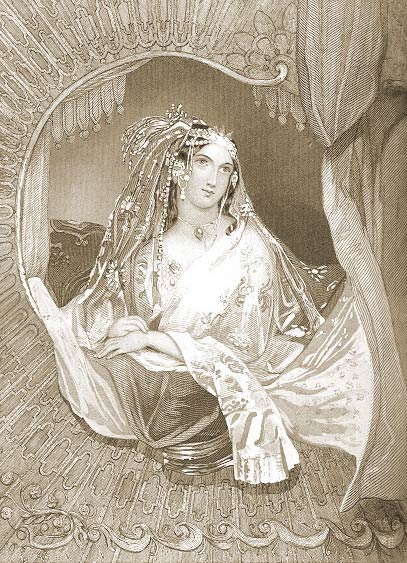
Lalarukh: Where two lovers rest

by Zeenath Jahan

I really cannot remember how many years it has taken me to visit Lalarukh's tomb. Many years ago I had heard an intriguing though vague story about her. It is very similar to Saima Waheed's story; except, her end was much more brutal.

In 1817 Thomas Moore had immortalized `Lallarookh' in his poem of the same name Before writing `Lallarookh', Moore had shut himself away for two years, reading oriental literature translated into English or French.

Moore's `Lallarookh' was Emperor Aurangzaib's daughter, engaged to the Prince of Bukhara. Since the marriage was to be celebrated in Kashmir, the Princess set out from Delhi in a magnificent cavalcade. During the journey, `Feramorz', a young Kashmiri poet, entertained the ladies with his ballads. By the time the Royal procession reached `Hussun Abdaul' the Princess was deeply in love with him.

In Kashmir a golden carpet was laid out for the Princess who, dragging her feet, went to meet her fiance. Her joy knew no bounds when she discovered that the Prince was none other than her Feramorz.

The real Lalarukh was not as fortunate. The lovers' nameless graves bear mute testimony to their tragedy. The story I pieced together was of a Royal Mughal Princess who committed the cardinal sin of falling in love with a common soldier. Leaping social boundaries, their love flourished. They met in secret until, unable to bear a moment's separation, they decided to elope.

I tried to imagine the turmoil in the Royal House-hold when it was discovered that the Princess had eloped with a common soldier. Some of the courtiers must have known about the affaire; others may even have helped the star-crossed lovers escape. Trackers must have been set on Lalarukh's trail, searching high and low, day and night; until the lovers were finally tracked down.

We know that retribution was swift and severe. The anonymous soldier was beheaded for his temerity. The Princess was bricked into a nameless grave in the middle of the compound, alive. A wall was built around the site, with sentry boxes at the four corners. The graves had to be guarded round the clock, to keep the curious and the sympathetic away; while the Princess slowly choked to death.

Today, only the stump remains of a tree that had witnessed the tragedy. It is dead, but for the rampant creepers covering it, which give it a semblance of life. Lalarukh too is dead, but her story lives on in a culture that continues to deny women their rights.

The guide at the tomb told us that before she had been bricked in, no one had dared to divest the Princess of her jewels. In 1902, archaeologists uncovered the Princess's corpse, still in all its finery and they built a grave over the hole they had made in the large square tomb, to make up for the desecration. The story of Lalarukh and her soldier was eventually pieced together from local folk-lore.
picture

To arrive at Lalarukh's tomb, we had followed a well marked route from main Hassanabdal Bazaar, off the G.T Road. The guide, Sajjid Mehmood was already unlocking the gates, even before my three-year old grandson and I had stepped out of the car. Although he said groups of tourists frequently visited the tomb, the locals do not seem to be used to having strangers amongst them. They dropped everything they were doing to get a good eyeful of us!

Before reaching Lalarukh's tomb we crossed another tomb facing an artificial fish pool. In 1589, Khwaja Shamsuddin Khwani, the Governor of Punjab, had built it for himself. He could not be buried in it when he died in 1599; because, by orders of Emperor Akbar, Hakim Abdul Fateh Gilani (d. 1589) and later his brother Hakim Humayun (1595), known as Hakim Hamam, were buried there.I wondered whether the change of plans had anything to do with Lalarukh's capture, but the guide could not say. He did tell us though, that the 1902 Archaeological team had discovered a vast treasure in the Hakim Brothers' tomb;which they removed to their own country.

Descendants of the original Goldfish and Rahu (fish) still inhabit the pool, which is fed by fresh spring waters from the bowels of the hill beside it. The original fish had worn golden rings. Their descendants are desperately trying to exist in a pool that the local populace treats like a trash can. Sajjid Mehmood was most apologetic, earnestly declaring that he had cleaned the pool that very morning!

A board near the tomb gives 1589 as the date when the fish pool and the Hakim brothers' tomb were built. The only information about Lalarukh's tomb is a board stating that it belongs to the seventeenth century.

No matter when she died, no matter how she died; today Lalarukh and her soldier rest in peace in a quiet garden. Who can tell who won in the end, the Emperor or the Lovers? They are together for eternity.

Friday, 3 May 2013

When Pakistan's ideology was on trial

The Hyderabad tribunal


Saturday, June 07, 2008

This June it will be 33 years since the trial of the leadership of the National Awami Party (NAP). Thirty three years ago the NAP was banned and its leader Wali Khan was tried on a number of charges. One of the most serious charges, in the words of the court, "the claim of the NAP and its leaders that the Pakhtoonistan movement was merely seeking renaming of two provinces was held to be totally untenable." The court observed that the NAP leadership was "actually demanding secession in the name of autonomy by carving out a new province and demanding complete self-government with only three subjects left to the centre."


Saturday, 24 November 2012

A leaf from history: The London conspiracy?


By Shaikh Aziz

During the second year of Zulfikar Ali Bhutto’s government, one fine morning the news media flashed a report titled London Plan. Since then the term has become synonymous for intrigues and sedition. Was it a fact or a drama that was staged to malign the Pakhtun leader Wali Khan and his National Awami Party (NAP), or an attempt to extend PPP rule to the province where the NAP had a coalition government with Mufti Mahmood’s Jamiat Ulema-i-Islam (JUI).

The government claimed that the discovery of an arms cache from Iraqi Embassy in Islamabad was a part of the conspiracy to break Pakistan and create a greater Balochistan by annexing Iranian Balochistan with Pakistani Balochistan. The arms were reportedly meant for the separatists of Pakistani Balochistan. Later it was added that the NAP was working for independent Pakhtunistan.
The NAP Baloch leaders, Bizenjo, Mengal, Gul Nasir v Wikipedia

It started in September 1972 when Kausar Niazi, the information minister and a close confidant of Bhutto, claimed that NAP chief Wali Khan and his colleagues had hatched a conspiracy to break Pakistan into semi-independent units. He alleged that this occurred when Wali Khan visited London for eye treatment. It was claimed that then Balochistan chief minister Attaullah Mengal and Balochistan Finance Minister Ahmad Nawaz Bugti met Bangladeshi prime minister Shaikh Mujibur Rahman in London and discussed the plan.

This was corroborated by a speech by the Baloch leader Nawab Akbar Bugti at Mochi Gate, Lahore, on January 31, 1973, claiming that Wali Khan and Attaullah Mengal had told him about the ‘Greater Independent Balochistan’ plan through which Balochistan would gain independence. He also claimed that the assistance for implementing the plan was coming from Greater Balochistan Centre in Baghdad. (We have never heard of any such centre in Baghdad, Iraq. It was all an orchestrated plan by ZA Bhutto to dissolve the Balochistan’s (non-PPP) government at the orders of Shah of Iran).

The reports about the London Plan appeared in news media in Pakistan as well as in the UK, which created a stir among the general public as they were just coping with the shock of separation of Bangladesh. Bhutto asked for an explanation from Bizenjo to which he reaffirmed loyalty with Pakistan but could not satisfy Bhutto. Subsequently, the Balochistan government was dissolved on February 14, 1973, while the KP government resigned in protest the next day. Wali Khan, Attaullah Mengal, Ghaus Bakhsh Bizenjo, Khair Bukhsh Mari, Mir Gul Khan Nasir, Habib Jalib — in all 52 activists were arrested.

The situation became very intriguing as NAP leaders rejected the government claim and said that the ploy was hatched by the then Interior Minister Abdul Qayyum Khan. When the story broke out in a London newspaper, Shaikh Mujibur Rahman on his own told The Times that the news was baseless and that it was engineered by the central government which wanted to create an excuse to dissolve the NAP-led KP government.

On the face of it the whole episode appeared to be a well-planned fiasco. It appeared true that the arms cache was meant for the Baloch activists but who would have distributed it? This could not be established. An open debate in the National Assembly was not allowed on the ground that it was a sensitive issue and involved a foreign Muslim country; this closed all possible explanations that could have surfaced.

One proposed argument sounds plausible: the Bhutto factor. The experience of the past 10 months proved that Bhutto did not like two border provincial governments in partnership of the NAP. Despite the Tripartite Accord with the NAP and JUI the centre did not fulfil many conditions that were agreed upon on March 6, 1972. Both the provincial leaders had been complaining about it but nothing was being solved. The interference in provincial matters was irritating both the governments. All that the NAP wanted was greater provincial autonomy and less interference in the working of the provincial governments.

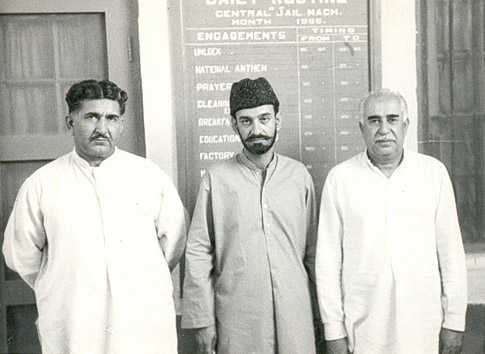
Hyderabad Conspiracy trial via Doc Kazi flickr
In the light of these developments, what was the truth about the London Plan? As the scheme of things unravelled, the plan seemed a well-conceived mechanism to slander the NAP leadership and its partner JUI. This was achieved. With the Presidential rule clamped, the ruling party had been able to break the party structure.

Later, a Hyderabad Tribunal was set up to investigate the allegations and prosecute those found involved in seditious activities. Since prosecution did not have ample evidence the proceedings remained almost dormant. Soon Bhutto got entangled in such a political mess that it led him first to become a hostage at the hands of Pakistan National Alliance (PNA) and later his hand-picked army chief Gen. Ziaul Haq who overthrew his government and sent him to the gallows. The Hyderabad Tribunal was wound up and all detainees were released, but only after rotting in jail till 1979.

-originally published by the Daily Times of Pakistan 31/10/12 . republished with permission for information purposes

Wednesday, 4 July 2012

Picture of the day

The Wali of Swat (date unknown) Miangul Gul Shahzada Abdul Wadood

                                              picture Copyright Mussarat Ahmedzeb.

Sunday, 1 July 2012

The King, the picture & the water carrier

Prologue:


In a recent documentary called Afghanistan The Great Game by Rory Stewart, he wrote about how the British Raj wanted to keep Afghanistan a backward state so as to serve as a buffer against possible incursions. He also touched upon the short but momentous reign of the reformist King Amanullah. This documentray led to a discussion about events surrounding his ouster which in turn led to Noreen Naseer and Peymana Walizai sharing some personal accounts of their family members regarding the role of British in toppling King Amanullah Khan's government.


Did the British Raj topple Afghanistan's first reformer King?


Accounts of the fall of King Amanullah of Afghanistan's government, taken from historical and personal accounts


 In 1924 amidst the rapid changes in reforms, the Mangal Pashtun tribesmen of Khost were stirred to revolt by a fanatical cleric called Mullah Lawang. The rebellion was crushed a year later but it was an ominous sign for those in government, especially for Mahmud Tarzi the foreign minister. He resigned in 1925 due to his advice on the need to proceed slowly and cautiously in the reform programme having been repeatedly ignored by Amanullah.
http://upload.wikimedia.org/wikipedia/commons/e/e5/Atat%C3%BCrk_ve_Amanullah_Han.jpg
Amanullah (R) with Mustafa Kamal Attaturk

In 1927 Amanullah Khan with his wife Queen Soraya embarked on a grand tour of European capitals where he was dazzled by the achievements of the west. He visited all the European capitals and also visited Turkey and Persia on his return journey, and was the first foreign ruler to visit the Soviet Union. It was during Amanullah Khans grand tour of Europe that word had reached the royal family in Kabul, my grandfathers family being one, that photographs of Queen Soraya, unveiled, wearing evening dress at European state receptions, having her hand kissed by foreign prime ministers and some even naked. Messages were sent to the Royal family that “The King has turned against Allah and Islam”. He was also reported to be bringing back from Europe ‘machines to make soap out of corpses’.No one really knew what to believe as these messages had been conveyed to them by British ministers staying in Kabul and so all thought best to wait until the King returned.

Return, revolt and Exile After his return to Kabul in July 1928 Amanullah announced a series of reforms before a Loya Jirga composed of the country’s leading tribal and religious leaders. He called for
 1) The establishment of a western style constitutional monarchy, a cabinet of ministers, an elected lower house, and a nominated upper house
2) The separation of religious and state power
3) The emancipation of women, enforced monogamy, compulsory education for all and coeducation schools.

The Loya Jirga (an ancient version of direct democracy similar to the traditional landesgemeinde of the older Swiss-German cantons) rejected most of Amanullahs proposals. So the King simply put together a Loya Jirga that was filled with loyalists to approve the proposals that had been rejected, especially the abolition of the chadari (veil) and the wearing of western clothes by the men. The wife of a British Minister in Kabul who was present on the occasion wrote in her diary, “The most dramatic moment of all was when Amanullah wound up an impassioned appeal to his people to free their women with a wave of his hand towards his Queen, saying “Anyway, you may, see my wife”, and she pulled down her veil before the assembled multitude”. Afghanistan’s conservative society was not ready for such changes, especially the Pashtun tribes in the rural areas.

Peymana Walizai writes:
'The hot summer of 1928 the King had returned from his grand tour and he had decided to visit his uncle Shaghasi Shaswar Khan Barakzai (my great grandfather) whilst on his regular trips around Kabul. During tea and talking about the grand trip, his uncle told him that he had heard news of the British arming Pashtun tribesmen near the border provinces. He said his workers from the south had come to convey a situation to him, and they had told him that after the photos of the Queen had been distributed the Mullahs had gone to pray, and there dug into in the ground were huge supplies of guns. The King told his uncle there was nothing to worry about and these were just rumours. He bid farewell to his uncle and got up to leave. As he was walking towards the gates of the house, my great grandfather suddenly remembered something he had not told him; barefoot he ran towards the gates, so as to not miss the king and stopped Amanullah. He called over his son, my grandfather and asked him to take his son with him and register him into a good school of the Kings choice. At that time my grandfather, Shaghasi Abdul Ghaffar Khan was a young boy and King Amanullah chose Habibya school in Kabul as the perfect choice for his cousin. The education my grandfather received allowed him to become a part of the Royal government of Nadir Shah. But like the rest of his family he too witnessed the downfall of one of the most modern thinking Afghan kings. '

The message that had been conveyed to my family in the presence of my grandfather turned out to be true as Habibullah Kalakani (Bach-e Saqqao (Son of a water carrier) marched on Kabul with a force consisting of the Mangal, Khostwal and Shinwari tribesman, to remove the King in the defence of Islam forcing Amanullah Khan to abdicate to Italy.

Habibullah Kalakani (Bacha-e-Saqqao) had in 1919 joined the Afghan Army but later due to low pay and poor facilities  left the army and did other jobs to sustain himself. His life after this is described by Noreen Naseer
'He travelled to Khost and came to Kurram (the tribal area under the protection of the British attracted him) and he was soon caught for stealing a goat. He was sentenced by a British Agent for theft and imprisoned him in Parachinar jail (narrated by Dr. Naseer Hussein as his father Malik Naad Ali Khan was in that durbar). According to Dr. Naseer Hussein, his punishment was a conspiracy to get him in contact with the British agents, as there is record of Bach-e-Saqqao’s offence. Trained as a soldier and supported by the British, he carried out propaganda against King Amanullah and his family, distributed Queen Suryaya’s pictures dressed up in western clothes.'


All this propaganda was so effective that the already aggrieved clergy, tribes and Maliks found these pictures and the lifestyle of the Queen so offensive to Islam that they supported Bacha-e-Saqqao against the King. Amanullah Khan fled to Italy with his family, and the existing Royal family were put under house arrest. Bacha Saqqao and his ragged followers arrived in Kabul and subjected the city and its hapless inhabitants to a nine-month reign of terror. The looting, pillaging and arson, and the rapes perpetrated by the wild invaders, alienated even those religious leaders who had opposed Amanullah, such as the influential Hazrat of Shor Bazar, the head of the Mujaddidi family and of the ancient Naqashbandiya Sufi order, who had first acclaimed the bandit as ‘The Holy warrior. Habibullah, Servant of the faith’.

General Nadir Khan, the hero of the Third Afghan Anglo war and a powerful member of the Musahiban family, also a Royal clan, with the help of his four brother assembled a force from both sides of the Durand Line and defeated the bandit force and took Kabul in October 1929. He publicly hanged Habibullah Kalakani with his leading followers a month later on the 3rd of November and Nadir Khan became the new King of Afghanistan.  

Epilogue:

So did the Britsh Raj fuel the ouster of Amanullah? How did Habibullah go from being a petty Army deserter imprisoned in British India's tribal areas to someone who could rally various tribes and oust an Afghan King? While their support for Nadir Khan is well known, historical references showing any overt support for Amanullahs ouster are mostly anecodatal. Perhaps someone needs to do a bit of research through the British Indian papers and answer this once and for all ?

References: 

  • Dupree, Louis (2002), Afghanistan,(USA: Oxford University Press)
  • Arney, George (1989),  Afghanistan, (London: Mandarin)
  • Rasanayagam, Angelo (2005), Afghanistan: A modern history, (London:I.B Tauris) 
  • Personal accounts on Amanullah Khan from Peymana Walizai whose Grandfather is Abdul Ghaffar Shaghasi Barakzai, the cousin of Amanullah Khan through his uncle Shaghasi Shaswar Khan Barakzai 
  • Personal accounts on Bacha Saqqao from excerpts taken from the diary of her father, Dr Nasser Hussein , by Noreen Naseer, as recounted by her grandfather, Late Malik Naad Ali Khan

Thursday, 28 June 2012

Denigerating the Hazaras - I

by Dr. Mohammad Taqi

The post-1978 ethno-national revival of the Hazaras has been a subject of serious scholarship, which apparently Mr Marri is unaware of An article titled “Balochistan: sectarian strife or Hazara community targeted?” written by Mr Surat Khan Marri appeared in these pages this past weekend. The piece is not just an extremely callous one but is littered with factual inaccuracies too. Given the prevailing situation in Balochistan and the important position of Quetta, where most of the Pakistani Hazara community resides, it is pertinent to set the record straight. Mr Marri starts with a not-so-subtle attack on the ethnic origins and the social and political status of the Hazaras in Afghanistan. He wrote, “The Hazara community may claim to be descendants of the Great Khan of the Mongols or a remnant of the Mughals/Mongol conquerors of India via Afghanistan. However, in their recent abode, Afghanistan, they are considered and treated as of low-caste, compelled to work as sweepers and clean latrines, like some Christians in Pakistan and Harijans in India. In Afghanistan, they are in a considerable number, maybe half a million, but in Afghan challenges or wars against the British, Russians, the recent resistance termed as the war on terror, American and NATO aggression, the Hazara community in Afghanistan has no role. Afghans blame them for collaboration with the US and Pakistan.” I find Mr Marri’s slur no different than, and perhaps picked from, 14-pages that the Afghan Gazetteer had dedicated to the Hazaras or Mountstuart Elphinstone’s 1815 drivel against the Hazaras. It is well known that Elphinstone never went beyond Peshawar, and even there, he stayed about four months and gathered information from people who had been fighting the Hazaras for ages. 

There is no hiding the fact the Hazara of central Afghanistan have historically remained at odds with the Pashtun dynasties of Afghanistan and faced extermination at the hands of the latter. Persecuted communities and especially those forced into internal and external displacement doing hard labour — I would not even call it menial or odd jobs — is not an uncommon phenomenon around the world. But Mr Marri has thrown the epithet to rule out a political role for the Hazaras in Afghanistan, and by extension in Pakistan, as he states later. 

On the eve of the 1978 Saur Revolution in Afghanistan, the Hazaras, like most other Afghans, were active on both sides of the political divide. They were a part of the Marxist movement in the 1960s, especially in the Parcham faction of the People’s Democratic Party of Afghanistan (PDPA). Affiliation with the Parcham earned them the wrath of the Khalq faction, which imprisoned thousands of Parchamis during the intra-party feuds of 1978. With the rise of the Parcham leaders Babrak Karmal, and then Dr Najibullah to power, the Hazara leaders like Dr Sultan Ali Kishtmand and the brothers Syed Nasir Nadiri and Syed Mansur were restored to power. Dr. Kishtmand remained the prime minister of Afghanistan until parting ways with the PDPA in 1991. Syed Mansur’s forces in Shiberghan and Baghlan had the status of the official PDPA government militia. On the opposite end of the spectrum, the rural Hazara uprisings against the PDPA started as early as 1979, e.g. in Waras and Yakaolang and led to the formation of Shura-e-Inquilab-e-Ittifaq-e-Islami and its various reincarnations, including an eight-party Mujahedeen alliance, and then the Hizb-e-Wahdat party of Abdul Ali Mazari and Karim Khalili (currently the second vice president of Afghanistan). 

The post-1978 ethno-national revival of the Hazaras has been a subject of serious scholarship, which apparently Mr Marri is unaware of. Another allegation Mr. Marri has leveled is that the Quetta Hazaras somehow exploited the local Baloch welcome – he fails to mention the dominant Pashtuns as the host population – and switched loyalties first to the British and then to the succeeding state of Pakistan. He says:” On their migration to Balochistan, they enjoyed and felt comfortable living in a Baloch liberal and heterogeneous society. However, they soon realized that power and the future lay somewhere else. They allied themselves with British employers and camp followers and had friendly relations with local Baloch-Pashtun collaborators.” Mr. Marri alleges that the Hazaras of Quetta found new patrons in the new Pakistan Punjabi/Urdu speaking elite and somehow were given more than their due share in government services, especially the armed forces. This assertion ignores the fact along with Hazaras like Qazi Issa, Pashtuns like Nawab Muhammad Khan Jogezai and Baloch like Nawab Akbar Khan Bugti Shaheed had also embraced the new power players like Mr. MA Jinnah – the same “Karachiite” that Mr. Marri castigates elsewhere in the piece.

Mr Marri then writes, “Because of their (Hazara’s) allegiance to the new power, the rulers were of the opinion that this minority may replace and fill the vacuum created by the departure of the British army Gurkhas. The Pakistan army started recruiting a large number of Balochistan-based Hazaras, some of whom rose to the rank of general — General Musa being one example; brigadiers (Brigadier Sharbat), and other high ranks.” Sharbat Ali Changezi was a Hazara but not a brigadier. I know this because his children were my schoolmates in Pakistan Air Force School, Peshawar in the 1970s/80s. Air Marshal Changezi served multiple tours of duty at Peshawar at the PAF base and then the Air Headquarters. Out of the two servicemen, Mr. Marri names to make his case, he is wrong about both. Even his spiel about Hazaras being a replacement for the Gurkhas is a farfetched one. The British had formed a Hazara Pioneers regiment but it was already disbanded by 1933.

 One will be hard pressed to find names other than General Musa and AM Sharbat Changezi in the top tiers of the Pakistani armed forces. Officers like General Musa were absorbed into the Frontier Force regiment and no Hazara ‘Gurkha’ regiment ever existed in Pakistan. Mr Marri’s claim that made the lead was, “When General Musa became the governor of West Pakistan, he declared the Hazaras a local tribe of Balochistan through an ordinance.” This assertion needs vetting as the Political Agent Quetta-Pishin issued the final notification declaring Hazaras and three other Afghan tribes, viz Durrani, Yusafzai and Ghilzai, as local/indigenous tribesmen of Quetta on June 22, 1962. The notification refers to two letters dated February 19, 1962 and May 10, 1962 from the Ministry of States and Frontier Regions. The dates put Nawab Amir Muhammad Khan of Kalabagh as the governor West Pakistan and General Musa as army chief, not governor. Regardless, it is the xenophobic and sectarian undertones of Mr Marri’s article that are of primary concern in the evolving situation in Balochistan. (To be concluded)
The writer can be reached at mazdaki@me.com and he tweets at http://twitter.com/mazdaki

Thursday, 3 May 2012

Looking for Taliban equivalents

Bestowing artificial legitimacy on aliens?

In a recent opinion piece, Mr. Nadir Hassan has drawn parallels between the present-day Taliban and the resistance movements in the federally administrated tribal areas (FATA) in the remote past. The writer asserts that he does not condone the Taliban atrocities but, unfortunately, he appears to rationalise that madness by his attempt to impart legitimacy of sorts by trying to tie them to the past struggles in that region.

Mr Hasan has focused on the anti-colonial, conservative religious figure, the Faqir of Ipi and has compared the Faqir of Ipi’s rebellion against the British Raj with the Taliban. The similarities between the two movements – if the Taliban can be called one - are far and few in between and the comparison is valid only in a very limited scope, if at all.

The writer has, for example, exaggerated the reach and influence of the Faqir’s uprising by calling it one of the ‘most successful rebellions’ which was actually not the case. The fact is the movement by the Faqir of Ipi was quite limited and neither had the capacity to nor did extend outside Waziristan. Like the Taliban’s Pakistani backers, the Faqir’s uprising had its foreign supporters in Germans and Italians. However, unlike the Taliban’s handlers, the Germans and Italians were aware that even with unlimited supplies he could not gather more than a thousand adherents or carry out a serious and sustained assault on British forces. The Faqir’s did conduct the classic hit-and-run guerrilla attacks against the British but really had no strategy to expand the scope of their rebellion, including tying it to the larger independence struggle in British India.

Unlike the highly Arabised and Pakistan-trained Taliban, the Faqir of Ipi’s movement was indigenous in nature, characteristics, norms, scope and influence. It was not driven by an anti-imperial ideology or any mooted anti-colonial phenomena. It erupted on the issue of handing over a Hindu minor girl to her parents by the British administration, following a complaint against a tribal man for abducting, converting to Islam and marrying the girl. The action taken by the British administration, of course, was highly commendable, especially when compared today with the complicity of present-day political and civil administration and the inaction of judiciary in similar cases.

The steps taken by the British administration were nonetheless conceived as an attack on the tribal code as well as against religious norms. The outrage against the perceived British excesses morphed into a decade-long insurgency. The indigenous nature of the revolt by default had to tap the traditional bastions of native culture and power i.e. the jirga (political assembly), hujra (social assembly) and the mosque (religious assembly). The former two power centres overshadowed or at least remained at par with the mosque – an exact opposite of the way Taliban movement evolved and prosecuted war. The Faqir’s men worked with the existing socio-political structures, which is in stark contrast with the Taliban zealots blowing up jirgas and decimating the tribal elders and their hujras. Not a shred of historical evidence suggests that the Faqir’s men went on a killing spree against the tribal leaders, common people, music or poetry recitals, village fairs and play areas, bazaars, shrines or mosques.

The very distinct composition of Taliban-ian Islam (as the writer asserted) is the attempt to bring down the existing socio-political structure and to extend their control by inflicting a puritanical version of Islam and waging a jihad against fellow Muslims considered guilty of idolatry, grave worshipping and adultery. Imposing rigorous prohibitions on music, dance and all forms of arts, and enforce punishments for not observing Islamic rituals, challenging tribal hierarchy and insisting on socio-religious equality of the people to win over support.

In his pursuance of finding out an equivalent from the region to dispel the impression of considering the Taliban as an unprecedented phenomena, he missed that the Faqir of Ipi was not a mullah; he was associated with a Sufi clan, a disciple of Pir Naqib of Charbagh, which makes him a Barelvi. Thus, his version of religion was more in line with the local interpretation of Islam (for instance, it is apparent from the use of music in his war parties).

Also, if he had researched about the descendants of the Faqir of Ipi, he may have found that the successor of the Faqir, his nephew, Niaz Ali Khan, was known for his conciliatory approach in tribal disputes, and his sons Abdul Jaleel, Abdul Wali and others were often inveighed by the local mullahs for inertness toward the religiously glorified war of Afghanistan and the current uproar in FATA.

The Faqir of Ipi’s opposition to the idea of Pakistan came from the political leanings favoured towards Congress and its allies in frontier region, the Khudai Khidmatgars. His support of the Pashtunistan was first influenced by this and later by his contacts in the Afghan Government, which lost grounds after Badshah Khan took an oath of allegiance to Pakistan and his military commander later surrendered to Pakistan.

Taliban roots in political and religious movements on Pashtun lands can be traced to the Wahhabi-influenced movement of Syed Ahmed of Bareli, who sought political control by declaring himself the vanguard of Islam, imposed centralised Sharia Laws, changing Pashtun traditions and norms with their version of Islam and challenging the traditional authority of Pashtun elders as well as the religious clergy by assigning themselves the authorities to arbitrate disputes and collect religious tax, as Zakat and Ushr. These steps by Syed Ahmed and his disciples from across India and among Pashtuns were rejected by the traditional Pashtun leadership as well as clergy. The alien movement ensued in an utter failure

Local tribal elders and people of FATA have the same feelings of agony towards the aliens and monsters aka Taliban; it is state support for perceived strategic interests which have enabled them to continue their beleaguering of FATA.

Originally published in Pakistan Today on Wednesday, 2 May 2012

The writer is a freelance journalist and can be reached at twitter.com/aliarqam

Tuesday, 1 May 2012

QOTD: Afghanistan & the first drones

"It is a matter of great regret that the throwing of bombs by zeppelins on London was denounced as a most savage act and the bombardment of places of worship and sacred spots was considered a most abominable operation. While we now see with our own eyes that such operations were a habit which is prevalent among all civilized people of the west"

                  -King Amanullah of Afghanistan (1919) writing about the British bombardment of Kabul