Sunday, 24 June 2012

Comments from Khyber

The fall of Tirah valley to the Taliban in Pakistan's Federally administered tribal areas has triggered a wave of internally displaced refugees. As part of our focus on challenging the narrative; local researchers Farooq and Shabir with help from writer  Noreen Nasser compiles information on the region for Qissa Khwani.
The mandatory orientalist reference for any article on the tribal areas

Some information and names have been changed to protect the identities of people.

Background: Located in the northwest of the Khyber Agency is the  beautiful and fertile Tirah Valley, the original home of all the Afridi and Orakzai tribes. Tirah Valley has two parts: one is in  Khyber agency and other is in Orakzai Agency.  In Khyber agency, eight tribes of Afridis are residing and are at war with each other for power between the militants groups ( Qamber Khail, Koki Khail, Malak din Khail, Zakha Khail, Aka Khail, Adam Khail, Sipah and Kamar Khail).

Presently in Khyber Tirah there are five major militants groups fighting for power and control: Lashkar- e -Islam (Mangal Bagh group, Mangal Bagh a bus conductor by profession). Ansar –ul- islam     (Mehboob group, Mehboob an imam of local Madrassa). Tehrik- e- Taliban (Tariq Afridi group an extraneous group, Tariq Afridi came from Dara Adam Khel a college graduate and brother of a Judge, Khyber Pakhtunkhwa Judiciary), Tauheed-e- Islam (Aman lashkar of Zakha Khel sponsored by Pakistan Army: sarcastically referred to as ' good taliban' ) and 'Amar bil maroof wa nahi ul munkar' ( Haji Namdar group controlling lower Khyber Agency).  Lashkar- e- Islam apparent agenda is to implement Islamic Sharia but according to local people Mangal Bagh has no knowledge of Islam, he simply wants to control Khyber Agency. This group has people from  all the tribes of Afridis, it was controlling Bara area but now due to military presence they are carrying out their activities covertly.

In Tirah, it is presently occupying Aka Khail and Sipah tribes and also has some presence in small pockets of Malak din Khail and Kamar Khail areas. No body exactly knows about this group hideouts as they are constantly changing places. But it is believed that Mangal Bagh a Sipah himself resides near Pak-Afghan border in the area of Sipah tribe and guarded by young boys age 15-21.Ansar- ul- islam group is the main militant group in Tirah. It controls Tirah Zakha Khail, partial Qamber Khail area, Malak din Khail, Adam Khail and Shalobar (was part of Qamber Khail now known as independent tribe area). They are staunch rivals of Mangal Bagh group in the valley. Due to their skirmishes and differences hundreds of people lost their lives and thousands were displaced in lower parts of Khyber Agency. Tehrik-Taliban Tariq Afridi group of Dara Adam Khel is presently stationed and controlling Koki Khail area of Tirah Valley. It is also one of the strongest opponent of Mangal Bagh in the valley as well as in the lower parts of Khyber Agency. Tariq Afridi group moved to Tirah valley due to Pakistan Army operation in Dera Adam Khel. This group influenced by Sipah-e-Sahaba was involved in sectarian violence and kidnapping. Besides kidnapping and killing, Tariq Afridi was also fighting another group back in Dara known as Momin Afridi Group supported by Pakistan Military (good Taliban). Momin Afridi group stationed in Dara Adam Khel has Pakistan Army’s support against Tariq because its activities are more based in Afghanistan. Tauheed-e-Islam (good taliban) is a newly formed group with the blessing of Pakistan Army to counter Lashkar -e -Islam also called Aman lashkar. It has limited control over the territory of Zakha Khail and failed to contain Lashkar-e-Islam in Tirah. Amar bil Maroof Wa Nahi Ul Munkar group founder was Haji Namdar later assassinated by a young boy while praying in 2008. In Khyber Agency, it was the pioneer militant group created to fight evils of the society. Lashkar-e-Islam is its splinter group but even they are not on good terms, clashes occurred several times between them.  Amar bil Maroof Wa Nahi Ul Munkar control Qamber Khail Bara area and some parts of Tirah.
  

The major questions are : who are fighting and killing thousands of innocent people of  Tirah, Khyber Agency? why they are fighting?, where they are fighting? and who suffers the most in their lust for power?


Lashkar- e -islam and Ansar –ul- Islam are the two major militant groups in confrontation with each other. Initially their clashes started in Malak din Khail area of Tirah Maidan and according to local people it was the peak of their cruelty and violence, brothers and cousin were forced to fight against each other. Here I would like to narrate a tragic story of Najib hailing from Tirah Valley. He was a student of intermediate (computer science),studious, humble, calm and a normal boy of eighteen and never harmed any one. He was forced to fight for Lashkar-e-Islam against Ansar- ul –Islam as he was the only young boy in his family, his elder brother was in United Kingdom and father was too old.
 It is mandatory for the people living in these militant controlled areas to handover one young man to fight the rival group. Najib was not trained for war, therefore he was used as a shield to protect the trained militants. This strategy was adopted by both the groups that untrained would be in the front line to protect the trained militants and if anyone tried to escape or leave, either his family would be harmed or that person would be slaughtered. Najib fate was no different from those who tried to escape, he was cut into pieces and delivered to his family in a sack. These  atrocities terrorized Tirah people so much that they never tried or had the courage to oppose any group. After taking over the Malak din Khail areas in Tirah, Ansar- ul -islam started its aggression in  Kamar Khail (Sokh Area), Akka Khail (Dars Jummat), Sipah (Saanda paal). But again after furious fighting with Lashkar-e-Islam surrendered back these areas except Shalobar.  According to informal sources more than 1500 people are killed from both sides and nearly 2500 were injured (these are estimates of militant death toll, local population is not included that was killed in a collateral damage). Interestingly both groups claimed their dead as martyred of Islam (Shaheed) and the other “murdaar”,(derogatory word of Pashtu used for dead).

In Zakha Khail area rein of terror was unleashed when Lashkar- e -Islam killed a religious scholar . In reaction to the assassination of their scholar Zakha Khail tribe formed a group with the help of Pakistan Army Tauheed-ul-Islam (good taliban). Before the emergence of this group Zakha Khail area was under Lashkar-e-Islam, major conflict areas are Nari Baba and Sur Ghar. During their skirmishes almost three hundred people lost their lives.

Who suffered the most?

All Afridi tribes were affected but we have tried to generally categorize on the basis of death toll, displacement, and other financial and property losses: Malak din Khail is the most affected tribe in terms  human, financial losses and displacement. Sipah tribe was affected financially due to closure of Bara Market since 2007, human losses are also there as they were forced to take part in those clashes. Shalobar is the second largest tribe in terms of human losses and also suffered a lot due to displacement. Kamar Khail occupies the third position in death toll and financial losses. Aka Khail can be placed at fourth position that suffered a lot after Kamar Khail Zakha khail their losses are less as compare to other tribes but after creating its own group suffered human losses recently from Mangal Bagh group (local people are quite skeptic about this army supported group).

Pakistan Military and its role?


Pakistan Army for the first time enter into the area of Tirah Valley in 2002, formed several check posts at Pak-Afghan border and also in Morga ( which connects with Tora Bora via Kurram Agency).

In 2007-8, army pulled out of Tirah and now there is no army camp, post or base. The FC and Militia is looking after the Pak-Afghan border and whenever needed Pakistan Air force is called upon to target militants causing huge casualties and displacement.  According to locals a Pakistan Army major excuse for pulling back was the lack of facilities in the hard terrain which creates problem in the supply for the security forces.

Why government  and army failed in controlling the situation:

According to local opinion government and army is not interested to eliminate militancy in Tirah. Government and Army excuse is that Tirah is a difficult terrain and they don’t have the resources to combat militants. The recent fighting in the Tirah Valley between Lashkar-i-Islam and Ansar -ul -Islam is for the control of Saanda paal. This area is strategically important because through Saanda paal peak the whole valley of Tirah can be guarded and controlled. Whoever gets the control of this peak, can control and if needed target Tirah areas.  Nowadays it is under the control of Mangal Bagh. It is pertinent to mention that Pakistan Army has left these groups to their own devices, waiting and watching but in this process of indifference hundreds of innocent people have lost their lives.

Friday, 22 June 2012

Peshawar: The land of my childhood

By Musafar

Land of my childhood, how I yearn for you
Your children so fair, maids as pretty as flowers
Handsome, stalwart sons brandishing guns as adornment
With gazes averted from our mothers and sisters
And your men courteous and true to their word
Your cities were the praise and envy of people from lands afar
Yea, they were called the Cities of Flowers
O where, O where, have you gone

Land of my childhood, how I yearn for you
The kehwa-khanas of Qissa-Khwani in Kabalae Darwaza
The seekh kababs of Sabiri astride the ganda nallah
The aroma of tikkae mingling with the dust and smoke
Roganae, kulchae, amrasae and zalobae to make you drool
Ucha mewa, sheer chai, and the chugha besides a winter log fire
The sitar to draw a chord and mangae with accompanying beat
O where, O where, have you gone

Land of my childhood, how I yearn for you
The citadel of Bala Hissar of my distant memory
With crumbling walls yet majestic and intimidating
The Chauk Yadgar, a confluence spot of yore for the mazdur
The Ghanta Ghar clad in its brick elegance striking the hour
The glory of Sethi Mohalla, a pearl set in an oyster
The masjids of Qasim Ali Khan and Mahabat Khan
The Samdo ki Gali of Kohati Darwaza
O where, O where, have you gone

Land of my childhood, how I yearn for you
The plaintive cry of the mashki filling mangee door to door
Sprinkling the parched earth on a hot torrid afternoon
The rich age of craftsmen priding themselves in their wares
A rich time when there was respect between the old and young
A rich time when one’s word was an irrevocable bond
The reverence and awe of the passing Moharram procession
The human sound of the azaan floating over the air waves
The clip clop of a horse drawn tonga a melodious beat
O where, O where, have you gone

Land of my childhood, how I yearn for you
But nay, tarry a while and ponder
How could you go away, it was I who abandoned you
Why didn’t you beckon me to stay and grow in your shade
Why didn’t you enfold me to your bosom from distant places
Why didn’t you reach out to me then, as I reach out to you now
Why didn’t you plead with me, not to forsake you to the wolves
O why, O why, did I go and forsake you my beloved

Land of my childhood, how I yearn for you
I berate myself for returning so late in the day
But I perceive a silver lining in the resilience of your being
May the Almighty cleanse your soul and restore your dignity
I shall cherish the day when, by His will, you shall rise from the ashes like the Pheonix

Land of my childhood, how I yearn for you

Thursday, 21 June 2012

The Life and times of Peshawar's Kaka Ram

By Naeem Safi

Gorak Nath Temple, at the Gor Khutree Archaeological Complex Peshawar, is now open for Hindu worshippers who regularly visit the site to pray.

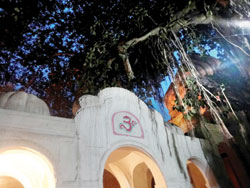
The sun has just disappeared behind the mountains. Beneath the long hanging branches of the old banyan tree, a devotee is sweeping leaves to clean the floor for worshippers who are expected to arrive in a while.

Hundreds of birds above are chirping before settling down for the night. The fenced lawns outside are full, with noisy children running around and playing, the adolescent sauntering on the paved walkways, and their mothers gossiping.

These late evening visitors are usually from the nearby mohallahs who come here to escape power outages — and take refuge in the Gor Khutree Complex.

The colour palette for the sky is rapidly changing and the light tones of gold are turning into crimson, and violets merging with dark greys. Calls for evening prayers over loudspeakers lure males of all age groups to the mosque at the north-western corner of the Complex.

Gorak Nath Temple, at the Gor Khutree Archaeological Complex Peshawar, was built during the Sikh period around 1834 to 1849. Their Italian General, Paolo Avitabile, used the Complex as his residence. The temple is now open for Hindu worshippers who regularly visit the site to pray to their gods.
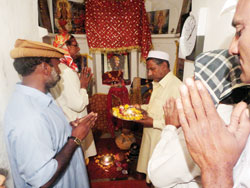
Just a few yards south, Kaka Ram, the seyvek, is giving final touches to the preparations in the Gorak Nath temple. Unlike the marbled floors and numerous fans at the mosque, his temple has earthen floor and a couple of helpers are connecting a power cable to the central building to light a few bulbs. Kaka Ram is waiting for the prayers at the mosque to finish, as some of his guests are Muslim, colleagues from his office at the secretariat, who will also attend Sheranwali Mata’s parshad tonight.

Six decades back, he was born in a humble little house adjacent to the temple. Many generations of his ancestors have served this temple before. His father died when he was seven. They were expelled from their ancestral house; his mother had fought back through courts. She won the temple back, in the year 2011, but their home at the compound is lost, almost forever, and she parted with life on the first day of last May.
According to Kaka Ram, more than 2000 people attended her funeral, the majority of who were Muslims. He recalls his childhood times, when the huge well under the banyan tree used to be frequented by parents with ailing children, both Hindu and Muslim,to receive ashnans, a sacrament that is believed to cleanse and protect its receivers from evil spells. His dealings and relationships with Muslim friends and neighbours are not tainted with biases or discriminations. They all celebrate Holis and Eids together and there is no purdah among their families, something reserved only for very close relatives in a traditional Peshawari society.

The Muslim guests have finished their prayers and are now waiting near the well for the ceremony to begin. Pundit Gokal has arrived from another temple to lead the prayers, and the number of worshippers is gradually increasing. The pundit is preparing a huge platter of fresh fruits at Mata’s mandir while the attendees are gathering in the arched aisle in the front. Following a few rituals, the congregation, with equal number of women, and quite a few children, started chanting the parshad.

The sky has turned deep blue and the banyan tree looks more imposing against it. The birds have gone almost silent. The visitors outside, in the lawns, are gradually thinning out and the peace of the night is gradually engulfing the compound, and the streets around it.

Originally published by The News on Sunday, 17 June 2012

Sunday, 3 June 2012

Passage to India: A Pashtun in Guwahati

By Aneela Z. Babar

Guwahati is characteristic of small town India caught in the struggle of coping with rapid globalization and still not able to successfully shrug off the time warp it has been living in for the past few decades. For years it has existed as the ‘gateway to India’s North East’ and tried to live down its reputation of being a violent little dot on India’s map suffering from insurgency in the 1980s and the all too famous Assam bandhs. However today it exhibits what Pankaj Mishra in Butter Chicken in Ludhiana: Travels in Small Town India discovered of similar former ‘unremarkable places’. These small towns ‘have shed their sleepy, half apologetic air’ and ‘modest’ is not an adjective that one can use for it’s inhabitants as they pursue their ambitions, appropriate brand names and ‘create a whole new pan-Indian culture’ (Mishra, 1995). So the city is caught in the chaos of gawking men from nearby villages trying to make sense of the Van Heusens and Tag Heuers on display in the shiny new malls, a constant influx of brand new cars jostling for space on dusty broken down roads and the traffic police bewildered by motorists who leave their cars parked on fly-overs. The expansive wetlands near the airport soon give space to the concrete jungle the city is turning into.

My second day in Guwahati finds me in the midst of the notorious Assam bandh. My host family is not sure the evening before whether it will be a ‘complete’ bandh or not and a flurry of telephone calls are exchanged across the apartment building. The barometer of a ‘complete’ read successful bandh is if the buses don’t ply early morning or the maid doesn’t turn up for work. The residents of the city are reconciled to bandh culture and take it in their stride. Though the city loses millions of rupees in revenue every month, no one seems overly concerned. It has long been a feature of their relaxed existence and it is only the burgeoning business class that is making polite noises now. The day goes by peacefully and in the late afternoon I decide to visit a local monument that gives a birds-eye view of the surrounding valley. Billed as Gandhi mandap, though everyone is unsure whether Gandhi ever visited the city, it is a research centre set up by a Congress government trying to build a profile in Assam’s heartland. The state had earlier been cool towards the Congress party post a rueful Nehru who apologized that mainland India could not do much to protect the region.

This was as China threatened to march through during the 1961 Indo-China war. An Amitabh Bachan who came garnering votes for his best friend Rajiv Gandhi was sent away garlanded with shoes by an incensed city that was still harboring its hurt. However, today the Congress sits comfortably in power. The Gandhi mandap has a surly Gandhi with his back to the city as he gruffly views the city’s young who find it a convenient place to escape the moral police in the valley.  

The Kabuli Wallah

I am eager to explore the city’s Pashtun population, they are the progeny of former money-lenders and fruit sellers who traveled frequently to the region. Many of them still carry on their ancestral profession of lending money and what is politely called ‘debt collection’ (Truant children are still cautioned of the Pashtun who will carry them off). Guwahati Pashtun form a fascinating microcosm of an immigrant population that has kept its ways in a city that is so different from their earlier homes. Saleem Khan who welcomes me to his home is in his late twenties and he says his family moved here from Ghazni. Saleem is one of the ‘settled’ families of the city, there is also a sub-class of transient single men who travel through the region. His living room seems out of a baithak in Quetta , though he says he was born here and has never been home. Afghanistan is a mysterious land which he tries to fathom through B-grade films and his parent’s tales. As I settle down on the floor cushions, he takes a mock interview of the intermediary who has introduced us. He explains it is ‘close to election season’ so these times make it necessary to be sure of who I am. His concerns allayed, he is quite the eager host, calling up assorted uncles and aunts on his mobile to make them speak to the visiting Pashtun. One uncle is quite sure that he has visited relatives of mine in my village. Saleem attempts to brief me about his life here, where we are sitting now are rooms attached to his ‘public life’, it is here that he conducts his work and entertains guests. His family lives in a separate Afghan colony some two hours away. He jokes that people in Guwahati claim that their community is very ‘cruel’ towards their women. Though women in his generation remain uneducated and live in seclusion, he assures me that the younger generation of women has started going to school. His parent’s generation stay in touch with family back home in Afghanistan through exchanging audio cassettes, I picture his mother recording our conversation today in an audio-letter home. Saleem speaks in the classic Pushto, unlike me he doesn’t speak a hybrid dialect. Perhaps over years it will be only the ‘first generation’ of Pathan diaspora like his that will speak the uncontaminated Pushto of earlier years. I am curious about Saleem’s money lending business and whether it has been effected by the budding finance companies in the region. Saleem says that he works with the low end of the market, with those who cannot afford the collateral that the organized financial sector requires. However, his services come with a hefty interest. Don’t borrowers default? He says he has a ‘scientific assesment’ process, the ‘applicant’s’ home is first surveyed for items of equivalent value which can be easily hauled away if anyone defaults on payments. And he says he can judge people in a manner the anonymous financial companies don’t. I inquire whether he gets into trouble with the police due to his high-handed tactics. It’s the first time in the afternoon that I see the arrogance that comes with his genes expressed in his conversation. ‘They know me, and no one messes with us. Everyone knows who we are’. Our interview done, Saleem struggles with being a good Pashtun host. I had come on short notice and he fears that he has not accorded me the welcome that demands my ethnicity. There must be something that I would like to take with me, he gestures towards his house. Could he arrange a loan for me he inquires after he has exhausted ideas.

Outside the Assamese Muslim families that neighbor his house are eager to invite me for a cup of tea. Like others in the city they ask me to make a list of ‘Pathan’ (read Muslim) sounding names for their children. Similar to diligent city officials and their love to ‘rename’ roads, schools and buildings I take a perverse pleasure on meeting the Wahdanas, Palwashas and Zaraks of the city ten years on.

Originally published in 2006

Aneela Z. Babar (Pindi/Delhi/Melbourne). When she is not busy being the bane of her three year old's existence, Babar works on gender, culture, religion and militarism (with a heady dose of Bollywood trivia).

Saturday, 12 May 2012

Bannu, Zia-ul-Haq, And Bhutto's Reincarnation

Qissa Khwani - story-telling. Hmm ... ! I remember a little story. Perhaps have told it many times in 140 words or less. Jokingly mentioned on my Wall. But somehow feel it needs to be retold.
------------------------------------------------------------------------------------------------------------
Year: 1988.
Place: F.G. School for Girls
City: Bannu
Characters: Talkative Little Girl, Frustrated Government-Paid Teachers, Jealous Little Boys and Girls, A Military Dictator and Other Dead and/or Forgotten People 

She was 9. She talked a lot. Loved being a monitor in her class 'coz it gave her the immense power of hitting other kids with the broken leg of a wooden chair that the teacher kept for control. As she barked at them to take out their hands from behind their backs so she could gleefully hit them so hard they would howl she thought to herself, "How I wish I was made monitor every day!" But before the first blow came down something inside her always winced - the terror-stricken faces waiting for the pain, the feel of wood on soft almost-baby flesh, the thwack and the quick redness spreading across the palm left her nauseous. "No! I can't let them see I am a weakling. They do the same to me when its their turn. Worse ... they laugh at me (and anyone else) when I cry. I'll do it even if it haunts me the whole long afternoon and evening and night back at home. Afternoon when I drive my brother's BMX up and down the scorching tarmac driveway of our yellow-bricked colonial Government residence. Evenings when I sit under the Jamun tree and collect the fruit with my purple-stained fingers singing songs I had made up. Nights when I slept in a huge bed between my two elder sisters and couldn't put away stories of the young English woman who jumped from our balcony many, many years ago and haunted the hosue. They are neither of them very huggable and I have a feeling its because they don't like me". And she would bring the wood cracking down without any feeling any more. 

This day was like any other day. The teacher dozed at her desk with hands placed on the table, fist under her chin. 9 year olds sneaked bites out of their lunch boxes unable to wait for break. The smell of half-fried eggs and parathas filled the hot Bannu afternoon. And something unusual happened! 

The Principal was a skinny old woman (40+ seems old at 9) with a stern mouth and unkind eyes. There were strange lines around her mouth and eyes though that were firmly and permanently crinkled in an unfamiliar way. They never deepened but they were there. Tell-tale signs of something the kids could never decipher. She was out of bounds for all kids. No one was ever supposed to greet her. They were too insignificant. But on this day she came into the class and made a grunt. 45 saucer-like eyes and wax-filled ears focused with all their might on her. What could she want? 

"Children whose fathers are in the Police stand up!" 
*crickets chirping*
Looking at the classteacher, "Who was that girl you were telling me about?"
"That's her, Ma'am" - and for one agonizing moment 45 erratic beating hearts prayed with all their might it wasn't them. And sure enough the finger pointed at her. "Dear God, no. Please whatever it is I have done I'll never do it again. Please save me this one time and I'll never miss a prayer or watch a Bollywood movie again". 
"Come forward! What is your name?"
*chirp chirp*
"I asked you a question!"
*chirp chirp*
"Is her father the *xyz*? You said she was the most talkative. What's wrong with her today?" 
Frantic classteacher, "Do you know who the president of our country is? Remember I told you all in class last week?"
Last week Baba had given her Rs. 10 and she had a feast with it at the canteen. Rs. 2.75 could buy a coke and with Rs. 0.25 you could buy a samosa. Also, a rupee could buy you 20 Fanty candies. But she knew the answer to that question any way. 
"Zia-ul-Haq!"

She was born on 4th April 1979 at 5 PM. No one ever let her forget that. It was the day Bhutto was hanged. It never made sense to her why or how that was important. All she knew was it was how her birthday was remembered. The guy who killed her was Zia-ul-Haq. The funny man with the big moustache who was shown on PTV all day long. He was the reason they sometimes cut-down the 10 minutes Danger Mouse cartoon that was shown every day at 4 PM. It was the highlight of her day and this man ruined it for her on many occasions.

"Good! Get her ready."
"Yes, Ma'am Principal!"

And then started one of the the most embarrassing moments of her life. The teacher gave her a bar of soap and made her sit next to the tap in the playground where she was a sitting duck for everyone from 1st grade to 5th. And the scrubbing started. It went on till her face was raw and her hands sting. A pathani-dress was produced from thin air and before she knew she was wearing it (the memory of how that happened is foggy). Teachers in the staffroom produced a white creamy stick that was smeared all over her face. Long nails were skilfully used to paint as near her tear-ducts as possible. She had to look white - she was a pathani! A blood red SwissMiss Lipstick was applied to her lips. The same lipstick was then used to add some color to her cheeks. After much fussing over when she was finally allowed to look in the mirror she almost squealed in terror. But oh well ...

Shame of shames, another classfellow was brought out all dressed up. Mortified, she looked around for someone to save her but no help seemed to be coming. She heard her jeering school-fellows make comments like, "Ooh look at the bride and groom". She almost died!

All she remembers after that is being handed over to a pair of complete strangers, men for that matter, who took them to the airport where a huge chopper almost blew her off her feet. She was given a bouquet to present to the guest. A bunch of grinning men came out of the heli and she was pushed to walk towards them. A man who looked familiar broke away from the rest and walked up to her, took the bouquet from her hands, smiled down and thanked her. 
Only when she reached home she was told that was the guy from TV. She was somewhat of a celebrity that day and it took out the sting from her earlier humiliation - just a bit of it.
Few weeks later on August 18, 1988, the president died in a "Case of Exploding Mangos". The story that went around in the family said she was the last kid to give him a bouquet. Not sure of the truth of that. But some called her Bhutto's reincarnation that avenged his death. 

------------------------------------------------------------------------------------------------------------
Of course the kid in the story is moi. Incidentally, my husband's birthday is 27th December.

Thursday, 3 May 2012

Looking for Taliban equivalents

Bestowing artificial legitimacy on aliens?

In a recent opinion piece, Mr. Nadir Hassan has drawn parallels between the present-day Taliban and the resistance movements in the federally administrated tribal areas (FATA) in the remote past. The writer asserts that he does not condone the Taliban atrocities but, unfortunately, he appears to rationalise that madness by his attempt to impart legitimacy of sorts by trying to tie them to the past struggles in that region.

Mr Hasan has focused on the anti-colonial, conservative religious figure, the Faqir of Ipi and has compared the Faqir of Ipi’s rebellion against the British Raj with the Taliban. The similarities between the two movements – if the Taliban can be called one - are far and few in between and the comparison is valid only in a very limited scope, if at all.

The writer has, for example, exaggerated the reach and influence of the Faqir’s uprising by calling it one of the ‘most successful rebellions’ which was actually not the case. The fact is the movement by the Faqir of Ipi was quite limited and neither had the capacity to nor did extend outside Waziristan. Like the Taliban’s Pakistani backers, the Faqir’s uprising had its foreign supporters in Germans and Italians. However, unlike the Taliban’s handlers, the Germans and Italians were aware that even with unlimited supplies he could not gather more than a thousand adherents or carry out a serious and sustained assault on British forces. The Faqir’s did conduct the classic hit-and-run guerrilla attacks against the British but really had no strategy to expand the scope of their rebellion, including tying it to the larger independence struggle in British India.

Unlike the highly Arabised and Pakistan-trained Taliban, the Faqir of Ipi’s movement was indigenous in nature, characteristics, norms, scope and influence. It was not driven by an anti-imperial ideology or any mooted anti-colonial phenomena. It erupted on the issue of handing over a Hindu minor girl to her parents by the British administration, following a complaint against a tribal man for abducting, converting to Islam and marrying the girl. The action taken by the British administration, of course, was highly commendable, especially when compared today with the complicity of present-day political and civil administration and the inaction of judiciary in similar cases.

The steps taken by the British administration were nonetheless conceived as an attack on the tribal code as well as against religious norms. The outrage against the perceived British excesses morphed into a decade-long insurgency. The indigenous nature of the revolt by default had to tap the traditional bastions of native culture and power i.e. the jirga (political assembly), hujra (social assembly) and the mosque (religious assembly). The former two power centres overshadowed or at least remained at par with the mosque – an exact opposite of the way Taliban movement evolved and prosecuted war. The Faqir’s men worked with the existing socio-political structures, which is in stark contrast with the Taliban zealots blowing up jirgas and decimating the tribal elders and their hujras. Not a shred of historical evidence suggests that the Faqir’s men went on a killing spree against the tribal leaders, common people, music or poetry recitals, village fairs and play areas, bazaars, shrines or mosques.

The very distinct composition of Taliban-ian Islam (as the writer asserted) is the attempt to bring down the existing socio-political structure and to extend their control by inflicting a puritanical version of Islam and waging a jihad against fellow Muslims considered guilty of idolatry, grave worshipping and adultery. Imposing rigorous prohibitions on music, dance and all forms of arts, and enforce punishments for not observing Islamic rituals, challenging tribal hierarchy and insisting on socio-religious equality of the people to win over support.

In his pursuance of finding out an equivalent from the region to dispel the impression of considering the Taliban as an unprecedented phenomena, he missed that the Faqir of Ipi was not a mullah; he was associated with a Sufi clan, a disciple of Pir Naqib of Charbagh, which makes him a Barelvi. Thus, his version of religion was more in line with the local interpretation of Islam (for instance, it is apparent from the use of music in his war parties).

Also, if he had researched about the descendants of the Faqir of Ipi, he may have found that the successor of the Faqir, his nephew, Niaz Ali Khan, was known for his conciliatory approach in tribal disputes, and his sons Abdul Jaleel, Abdul Wali and others were often inveighed by the local mullahs for inertness toward the religiously glorified war of Afghanistan and the current uproar in FATA.

The Faqir of Ipi’s opposition to the idea of Pakistan came from the political leanings favoured towards Congress and its allies in frontier region, the Khudai Khidmatgars. His support of the Pashtunistan was first influenced by this and later by his contacts in the Afghan Government, which lost grounds after Badshah Khan took an oath of allegiance to Pakistan and his military commander later surrendered to Pakistan.

Taliban roots in political and religious movements on Pashtun lands can be traced to the Wahhabi-influenced movement of Syed Ahmed of Bareli, who sought political control by declaring himself the vanguard of Islam, imposed centralised Sharia Laws, changing Pashtun traditions and norms with their version of Islam and challenging the traditional authority of Pashtun elders as well as the religious clergy by assigning themselves the authorities to arbitrate disputes and collect religious tax, as Zakat and Ushr. These steps by Syed Ahmed and his disciples from across India and among Pashtuns were rejected by the traditional Pashtun leadership as well as clergy. The alien movement ensued in an utter failure

Local tribal elders and people of FATA have the same feelings of agony towards the aliens and monsters aka Taliban; it is state support for perceived strategic interests which have enabled them to continue their beleaguering of FATA.

Originally published in Pakistan Today on Wednesday, 2 May 2012

The writer is a freelance journalist and can be reached at twitter.com/aliarqam

Tuesday, 1 May 2012

QOTD: Afghanistan & the first drones

"It is a matter of great regret that the throwing of bombs by zeppelins on London was denounced as a most savage act and the bombardment of places of worship and sacred spots was considered a most abominable operation. While we now see with our own eyes that such operations were a habit which is prevalent among all civilized people of the west"

                  -King Amanullah of Afghanistan (1919) writing about the British bombardment of Kabul