Showing posts with label Peshawar. Show all posts

Saturday, 19 January 2019

Chasing 'A Boy Across The River'

Chasing 'A Boy Across The River'

Dr. Nafees Ur Rehman (@NafeesRehmanDr)

A tale of how a girl across the river became a boy and cheeks turned into bottoms like peach over a period of about 100 years. 


Last summer, I was reading the memoirs of Major Maurice Patrick O'Connor Tandy, who had worked for the British-Raj and was posted Assistant Commissioner Kohat through1940-41.  In this book THIM DAYS IS GONE, I came across a love-song Zakhmi Sandara which he says was being played endlessly on loud speakers in Peshawar. The alleged translation by the British, according to him, of a couplet of which go like this.  

There is a boy across the river with a bottom like a peach
But alas! I cannot swim

I was really surprised that such an explicit (rather obscene) song could have been played at Peshawar that too in public and on loud speakers. We know that in those times even loud-speaker was termed as a tool of devil and religious fanatics had issues fatwas against its usage. However, I kind of believed that this love-song might have existed owing to the deplorable practice of Shahid Bazi /Bacha Bazi in this part of the world.  I went on and posted this excerpt on Twitter. There Barmazid, a Pashtun history enthusiast and blogger responded to it saying that he had seen mention of this love-song in the works of the novelist John Master. John Master is the same novelist who invented the Execution By Golden Shower theory where he fancies that the tribal Pashtun women would kill captured British soldiers by urinating into their mouths. 

What I didn't know that William Dalrymple, a celebrated historian from Scotland based in India, had also mentioned this couplet in his book Return of a King: The Battle for Afghanistan on page 17. He had posted it on Twitter in 2013, as attached below. 

It strucked me when I saw that these couplets were attributed to Khushal Khan Khattak, a celebrated Pashto poet whose poetry was first translated into English in 1880s for that it talks of courage, bravery, character and love. Elphinstone remarks on Khushal Khan Khattak in his History of India as  "Khushhal Khan, the Khan of the Khataks, who was a voluminous author and has left several poems written at this time for the purpose of exciting the national enthusiasm of his countrymen. They are remarkable for their high and ardent tone, and for their spirit of patriotism and independence, so unlike the usual character of Asiatics."

د افغان په نـنګ می وتړله توره 
نـنګیالی د زمانی خوشال خټک یم

It is for the Afghan honour that my sword I have bound beside me, 
I Khushhal Khatak am the only proud Afghan of the day!

So it was troubling to accept that a chieftain of Khattaks, a warrior and poet could have written such obscene couplet. Upon inquiry of the source of this couplet, William Dalrymple pointed to Soldier Sahib by Charles Allen. However, there is no mention of the love-song, let alone any primitive source for this couplet. This left us confused.

The confusion, however, served as motivation to trace the origin or any earlier mentions of the couplet in Pashto and in the colonial literature. I came across multiple mentions of this love-song in the colonial-literature some calling it Zakhmi Sandara (Wounded Song), others Zakhmi Dil (Wounded  Heart) but, unfortunately, none in Pashto. Fortunately enough, it is now possible to solve the riddle of the love-song, from the colonial literature alone.

This love-song appears in the book On secret patrol in high Asia by Latham Valentine Stewart Blacker, published in 1922. I quote the lyrics and the musical tune from this book below.
Source: On Secret patrol in high Asia,Blacker, L.V.S, p-185, 1922.


There's a girl across the river,
And her cheeks are like a peach,
But, alas ! I cannot swim,
Though we all know what would happen
If a Pathan hove in sight,
And if he could only reach. 


So now we have part of the answer i.e, the original lyrics do not talk of boys neither of bottoms; but of girls and cheeks.  This also confirms that the later usage of the couplet was, surely, result of corruption or modification. Now read with me the following excerpt from The Pathan Borderland by James W. Spain, published under auspices of Near and Middle East Institute of Columbia University in 1965.

"Many of the songs and stories which are repeated in Pathan villages are reminiscent of the versatility of the folk literature of medieval Europe. One of the best known is the Kabuli love song, Zakhmi Dil, "Bleeding heart", which in altered cadence and with revised (and very obscene) words was a favorite marching tune among Pathan soldiers of the British [Raj]."

Based on the above excerpt, we can confidently say that the original lyrics were modified. I came across two other mentions that the British-Indian soldiers would march to this tune during World War I, which means that the original love-song was there before the World War I and the modifications to it took place either before or during the war period.


The last and important question is, when was the modified couplet attributed to Khushal Khan Khattak. As mentioned above, William Dalrymple has quoted Soldier Sahib by Charles Allen published 2000 as source of the couplet but as I have said earlier, the book does not mention it at all. However, Charles Allen had talks about it in one place in his earlier work Plain tales from the Raj: images of British India in the twentieth century published in 1986. He talks just in one place of the love-song as shown in the following excerpt.

But gives no detail of the poet. I have not [yet] found any mention of the original or of the modified lyrics that attributes it to Khushal Khan Khattak except that of William Dalrymple's. in Return of the King.
I can confidently say that it is because of the absence of any reference that when Barmazid asked him again the other day,  William Dalrymple tweeted that the attribution of the couplet to Khushal Khan Khattak is an error and, that this error will be corrected in the future editions of the book.

On a last note, I thank Barmazid for pointing out this error and for standing to correct it.  I also thank William Dalrymple for his friendly yet professional interaction with us on this topic and for having agreed to correct the error.

Lt. Colonel Rogan
[Extracted from Fifty years of Army music]  

Edit: According to Queen's Royal Surreys website[extracted Jan 20, 2019], it was Lieutenant Colonel J MacKenzie Rogan, an army musician, who composed music on Indian themes while at Calcutta in 1885. And it is believed that he was the first one who re-arranged the tune of the famous Zakhmi Dil song for Army Bands. 


Monday, 23 September 2013

Remembering Peshawar's All Saints Church

- This piece was published in 2007 by a regular QK contributor

By Ali Jan

The church in the British India had an important purpose. In addition to the institution's role in missionary work and conducting regular religious services, it was also essential for performing baptisms, marriages and funerals. The subcontinental landscape is dotted with numerous old churches from the colonial era. Most of these have been built in typical European and gothic style. However, the All Saints' Church (built 1883); located inside the Kohati gate of the old walled city of Peshawar is an architecturally unique place of worship that bears a striking resemblance to an Islamic saracenic mosque with minarets and a dome.

Before 1883, the old city native congregation worshipped in the nearby Edwardes Mission School. The school is the oldest in the Frontier region and is located at a stone's throw from the church. It is named after Herbert Edwardes, the commissioner of Peshawar who helped in setting up the Peshawar Afghan Mission in 1853. After the British annexation of the city in 1849 the property where the present school stands was confiscated by the government and handed over to Major (later Colonel) Martin to establish the first educational institution in the North West of India. But it was sadly demolished a few years ago and replaced with tacky new construction to make new classrooms.

Another place of worship in the old city was a small reading hall known as Anjuman (or Mission Chapel) under an ancient tree in Peepal Mandi where missionaries often preached the gospel to passing Afghans. Actual conversions by natives in this part of India were rare. Rev T.P Hughes, missionary in Peshawar from 1865 to 1884, felt that Christianity should have some fitting external embodiment like a mosque. He therefore spared no pains to begin construction in the vicinity of Edwardes Mission School and started collecting the necessary funds. He purchased a piece of land to build a church and a pastor's house. In July 1882 a fund raising bazaar was held in Simla on the instigation of Lady Aitchison, the wife of the Governor General of India to collect Rs. 21,000.

Rev. Worthington Jukes one of its founding members records, "It was decided that the church should be oriental in aspect, cruciform in shape, with a dome in the centre, minarets flanking the front and each transept. General Follard (Royal Engineers), very kindly helped with working plans, dimensions etc... Foundations were duly laid in August 1882 and by the time contracts were signed for the building in December, the foundations had solidified, ready for immediate building... the summer of 1883 saw the Church roofed in, and the plaster work pushed on."

The church was opened on St John's Day, December 27, 1883. The foundation stone was laid by Captain Graves whose widow presented the brass desk on the Lord's Table. A plaque on a wall records: 'This church is erected to the glory of God and dedicated to the memory of All Saints in the year of our Lord Jesus Christ 1883.'

The mosque-like architecture adapts splendidly to the purposes of Christian worship. The columns, minarets and oriental arches are flawlessly symmetrical. The church is aligned to face Jerusalem and bears text calligraphy in Persian on its frontal facade.

It is open to visitors on ever Sunday. The church-staff is very courteous and the Vicar Rev SP Asghar, who is a dear man, often takes the guests around personally whenever he is available. The interior is exactly as it was more than a century ago.The church has the capacity to hold about 200 people. Inside the entrance is a rare photograph of Reverend Jukes in native Afghan dress.The walls are covered in texts in various languages spoken in the city in old times such as Persian, Urdu, Pashto, Arabic, English and Hebrew. The altar contains a beautiful screen of intricate wood carving (the pinjra-work for which Peshawar was famous). The inscription on the brass lectern indicates that it was 'presented by Miss Milman, Sir Richard Pollock and the Reverend E Jacob in memory of the Bishop of Calcutta, Robert Milman.'

A curved passageway leads to the ambulatory behind the altar and the wooden screen. Dozens of white marble memorial plaques are displayed here. Amongst them is a tablet to the memory of the notorious outlaw Dilawar Khan who converted to Christianity, and later joined the elite Corps of Guides and died whilst in their service in 1869. Conspicuous among these is the name of Miss Annie Norman, daughter of Sir Henry Norman, K.C.B., who died at the age of 27 after only one year's work among the women of Peshawar, and lies buried, according to her wish, in the native Wazirbagh Christian cemetery in the city -- the only European there. There is also a tablet about Rev Isidor Lowenthal, a Polish Jew convert who after becoming convinced that the Pakhtuns were the lost tribe of Bani Israel chose to work in Peshawar to 'serve his brethren.'

Another memorial plaque recounts the services of Vernon Starr the martyred missionary whose wife Lilian Vade Starr, matron at the Mission Hospital, travelled deep into the Tribal Areas to rescue Molly Ellis, a young Englishwoman who had been kidnapped by the tribals and brought her back safe. This historic incident made international headlines back in 1923.

The visitors are often shown an old bible in Hebrew and English dated 1806, with a brass latch engraved with 'Peshawar City, Afghanistan' that memorialises the deep historical links with the Afghans. It is pertinent to mention here that Peshawar was once the winter capital of the kingdom of Afghanistan which is the reason why the Frontier still bears a striking likeness with that country.

One can climb onto the parapet built around the domed roof. A curious story -- probably apocryphal -- is told of 13 brave Christian men who laid down their lives one after another whilst trying to fix the cross atop the church in its early days. According to the workers at the church, they were all martyred in the process by locals who were opposed to its opening. While narrating the account one of them will even point to a few 'bullet holes' near the cross to substantiate their claim. Apocryphal as it might sound, to any sceptic listener, it is still an interesting story! There is no evidence of it in the church records nor in the memoirs by any of the missionaries. What is more, let's suppose the story is not mythical then there should have been at least a commemorative plaque mentioning it but none exists.

The building which is now almost 124 year old is beginning to show signs of aging and has developed minor cracks at a few places lately. A local proactive group the Frontier Heritage Trust (FHT) which lobbies for preservation of built heritage in NWFP has included All Saints' Church among other buildings in a list complied by its experts. It has appealed to the government authorities for proper notification of endangered historic buildings in the Frontier and to declare this church a protected national monument under the Federal Antiquities Act 1975. It is hoped that the concerned departments will pay heed to their plea so this building can be preserved for our future generations.

- Republished with permission from The News on Sunday (15-04-2007). originally published under the title Mosque-like
The 124 year old All Saints' Church in Peshawar is waiting to be declared a protected national monument

Sunday, 16 December 2012

Peshawar: Enemy past the gate

Originally published by the News
Saturday, December 08, 2012, re-posted today after the recent attack on Peshawar airport-ed 

How do you tell the difference between apathy and fatalism? This is the question a few concerned citizens of Peshawar often ask themselves every time they hear of another rocket attack or suicide attack or another story of a piece of the city’s heritage being lost.

This attitude reminds me of the story of a king who defeated a proud opponent. The cruel king wanted to teach the man a lesson and killed one of his three sons. Inviting the father to dinner, he served his enemy the remains of the man’s son to him. As he saw his beaten enemy, eating he told him the gruesome truth and ordered him to keep eating. The elderly man briefly paused and with a sad face continued to eat. Afterwards the king’s minister, revolted by the king’s actions, asked the poor man how he could continue eating. The man replied, “I had three sons. Two are still living.” Such is fatalism....

The terrorist attacks in Peshawar rarely get much attention and it is even rarer for the effects of these attacks on the city to be reported. Geographically the city covers 1,257 square miles and four National Assembly constituencies. It is unique in that it borders three tribal zones – the Khyber Agency, Darra Adam Khel and the Mohmand Agency.

Khyber Pakhtunkhwa has suffered 166 suicide attacks, with 1,930 dead and 4,502 injured, from 2006 to 2012. In the first three months of 2009, there were 200 kidnappings for ransom in Peshawar, from 599 in 2006 of which only three led to convictions. The city suffered a staggering 120 incidents of terrorism in 2011 averaging ten per month.

In all this, one would expect the government to have invested in the Frontier Constabulary (FC), and the police, by recruiting extra manpower and intelligence operations. Instead of that, from 31 police stations in Peshawar in 2006, there were 30 in 2008. There have been 235 policemen killed and 496 injured; the killed include well known figures like the late Safwat Ghayur and Malik Saad. Breaking it down, two DIGs, three superintendents of police (SPs) and a number of DSPs and station house officers (SHOs) have been killed since the last quarter of 2006.

With one fourth of the Frontier Constabulary deployed outside the province, 119 men have died with 247 injured. Despite this, an official of the federal interior ministry informed the Peshawar High Court that a quarter of the force was deployed outside the province. While 367 FC platoons were deputed within the KP and Federally Administered Tribal Areas (Fata), only 78 were assisting provincial police and 109 were active in different army operations and another 95 FC platoons deputed outside KP of which 45 were deployed in Karachi, 35 in Islamabad and 15 in Gilgit-Baltistan.

To add insult to injury, the city’s plight is not due to a lack of political representation – out of the two ministers in the federal cabinet both Ghulam Bilour and Arbab Alamgir hail from Peshawar. Within the Khyber Pakhtunkhwa assembly, both the speaker and deputy speaker are from Peshawar, while one senior minister and three provincial ministers are from Peshawar. Their collective inability to mobilise the federal government or build support for the battered city in the country speaks volumes about the failure of leadership. There is also a lesson for the rest of Pakistan in the plight of Peshawar, as the attacks this Muharram have shown – a problem allowed to fester somewhere in the country will eventually become a problem everywhere.

The writer is founder of the site www.qissa-khwani.com and tweets @qisskhwani

Tuesday, 7 August 2012

My Hero: Safwat Ghayur

Postcard from Delhi: Aneela Babar tells her child the story of her hero Safwat Ghayur 


by Aneela Z. Babar

Dear Child,


Three days into the month had me waking up one night in tears. A long time believer in signs and dreams I spent some time calling up your father cautioning him to be careful in the coming days. I was still not restful and woke you up a couple of times in the night as I paced about the room, praying for mercy. In my selfishness I feared the Purvey of the Horrors To Come to visit only my boys. I never imagined that my sister of the heart who as a child would finish that offensive mug of milk for me would now put her lips to the poisoned cup of pain for us as well. I am glad we were here in Pakistan for this my son, and that at some level you  too absorbed some semblance of what service to the nation beyond the call of duty means. That you could register the different colours of love, of valor, of courage, of facing pain with dignity. You were in the presence of a very brave woman that was generous with her compassion and patience. At a time when I raged and ranted (the tears were yet to come) it was only the touch of her cool hand in mine that reminded me how very blessed I am to have her and hers in my life. In the years to come you will hear many stories of a very brave man who smiled his ways into all our lives. He was our hero, now he will be yours. His story is not over, he was a most unusual person for our times and our world, I wait to see how the next chapter unfolds.

 Sarfaroshi ki tamanna ab hamaare dil mein hai.
Dekhna hai zor kitna baazuay qaatil mein hai
Karta nahin kyun doosra kuch baat cheet,
                             Dekhta hun main jise voh chup teri mehfil mein hai 
Aye shaheed-e-mulk-o-millat main tere oopar nisaar,
Ab teri himmat ka charcha ghair ki mehfil mein hai
Sarfaroshi ki tamanna ab hamaare dil mein hai.


 The desire for sacrifice is now in our hearts
We shall now see what strength there is in the boughs of the enemy.
O country, Why does no other speak?
Whoever I see, is gathered quiet in your party...
O martyr of country, of nation, I submit myself to thee
For yet even the unacquainted speaks of thy courage
The desire for struggle is in our hearts
We shall now see what strength there is in the boughs of the enemies.
When the time comes, we shall show thee, O heaven
For why should we tell thee now, what lurks in our hearts? 


Though I could have also played around with another famous dialogue from the film


Safwat Ghayur ke dushman ka sirf ek hi kasoor hai ......ki woh Safwat ka dushman hai! ...

    You can charge Safwat's enemy of but one crime...that he is Safwat's enemy

but you get the gist:
(July 14, 1959 – August 4, 2010) 

But going back to the enigmatic Mr Ghayur. Yes, I don’t think his fan group was remiss in placing him on a pedestal, not for him the human vices of sloth, pride, vulgarity, boorish behaviour or pettiness and laziness as someone who was born to such good fortune as him could have succumbed to—somehow this suave French speaking, globetrotting, head strong, incorruptible law enforcer reminded you of the heroes from popular cinema who would battle baddies, dodge bullets, with not a crease in their well stitched suit – and here I am leaning towards a certain Secret Service Agent and not the Jat, for our hero preferred to deliver his killer lines at a lower decibel. 


Interesting aside: Mr Ghayur has been to the local cinemas, well at least for one Pushto movie when he chaperoned a visiting friend. The said friend was pretty scandalized with our domestic fare and declared it made French erotica seem like a training manual by the Taleban for virtuous behaviour (or words to that effect). But I guess this excursion of his, gives us just cause to add the line “he was a patron of the local arts” to his resume, lest he sounds too pucca saheb for you.

Yes, yes nothing got to our debonair man in uniform, not battling the thugs, nor sweating out in the thanas, and the various encounters he found himself in--- or made sure that he made a detour to “find" himself in. Yes, not even the most hair raising adventure of all --that has people tearing out their hair ,  running out of the house in their pyjamas. Raising two under-twos!! Yup, he did that too. Unfazed, and as quite the dapper gentleman.


I first encountered this gentleman as the paramapada of an elaborate game of snakes and ladders a very charming young woman outlined on the dining table for her elder sister. That the young woman went on to marry the hero of our tale is- well -another story. She is a bit vague with the details, but how fortuitous for someone who answered  a "police officer" (when asked what she wanted to be when she grew up), to marry one when she ended up  in medical school instead.

But the same person who introduced us to Hotel California, played Everyone Loves Kung fu Fighting in a band in Bangkok. He had friends who set up restaurants in Islamabad THAT WERE OPEN AT 9 pm (which was really cool for a city where you walked on the wild side if you spoke to someone in a different BPS grade than you),  who drove off with his new bride in a car come rukhsati time, and a very nice car I should add! ALONE! gasp!(with no sisters, cousins, and the ubiquitous five year old niece who will tug at the bride’s veil for the entire journey) in the process scandalizing all the old aunts and well the not so old amongst us as well.

He was also the good son who abandoned a really good first job offer (yes teaching karate is a pretty fine job) to accompany his family back to Pakistan, who might have dreamed of joining the foreign service (and would have been very good at it ) but chose instead the police so he could be around when his family needed him –and in turn took care of a family far far larger than his own. Ok, fine! maybe, we should go ahead and call him the desi hero after all!

I don’t think I am the stage in my life when I can find meaning in the things that happen to our heroes—but I do find comfort and a lot of laughter in the image of the foolish young man who goes up there believing himself to be a martyr with all the 70 houris and rivers of milk and honey it brings and encounters Safwat Ghayur instead. 

Yes, perhaps there is some divine justice after all...

Aneela Z. Babar (Pindi/Delhi/Melbourne). When she is not busy being the bane of her three year old's existence, Babar works on gender, culture, religion and militarism (with a heady dose of Bollywood trivia).


ed note: some months ago, a man was stopped by the police at a crossing in Peshawar. ' Why can't I pass?' Sorry Sir he replied his boss was passing, his boss you see was a brave man you see and the target of the Taliban. 'A brave man? You only had one brave boss his name was Safwat Ghayur and he is dead!'
RIP Safwat Ghayur and all those who have fought the good fight

Friday, 27 July 2012

Rajesh Khanna: The Prince of Romance


originally published by Outlook India and Daily Times Pakistan
Beyond Borders
picture copyright Hindu 


Many say Jitin Arora was born in Amritsar, India while some others claim he may have been born in Burewala in what is now Pakistan but most agree that as Rajesh Khanna he lived in the hearts of millions from Kabul to Kolkata, and beyond. I say most, as even when the prince of romance is mourned everywhere Hindi and Urdu are understood, some like a Pakistani television anchor Talat Hussain opted to deride him quite viciously. In his show dated July 19, 2012, which can be found at http://bit.ly/MuFrV3, Mr. Hussain disparages the media coverage of Rajesh Khanna’s demise on the pretext of evaluating its news value. The anchor’s barely concealed xenophobia is most unfortunate but let it not take away from what Kaka, as Rajesh was affectionately called, meant to literally hundreds of thousands of Pakistanis.

Pakistani governments had opted to first levy heavy taxes on the Indian films to curb import and then banned them initially in the western wing in 1952 and eventually even in East Pakistan by 1962. But it is still hard to erect barriers to popular culture, especially where the historical and linguistic bonds unite people despite the state ideology or political dispensation. When Doordarshan India started its telecast to Lahore it attracted not just the locals but also many others who could manage to travel to Lahore. On the other hand, Peshawar’s lifeline to the Indian cinema turned out to be the metropolitan Kabul of 1960s and 1970s. Theaters like the Temurshahi, Kabul Nandareh, Zainab Nandareh and Behzad screened new Bombay movies in Kabul. And as one Peshawari elder put it, they “descended upon Kabul to watch Aradhana in hordes”. Indeed one need not look beyond that 1969 release to grasp the magic of Rajesh Khanna.

The chemistry between Rajesh and his leading lady Sharmila Tagore in Aradhana, and thereafter, was almost palpable. Add to it Kishore Kumar and Lata Mangeshkar’s playback rendition to Sachin Dev ‘SD’ Burman’s music and there was no looking back for Rajesh. The beat, rhythm and use of orchestra to produce an exceedingly contemporary melody – as against SD’s semi-classical and folk-based tunes - in one song at least, also had the unmistakable fingerprint of SD’s son Rahul Dev Burman, whose name appeared as the assistant music director. Kishore Kumar and RD Burman became to Rajesh what Mukesh and Shankar-Jai Kishan were to the great Raj Kapoor. The trio did some 32 movies together. Rajesh was to later say to the documentary filmmaker Jack Pizzey about Kishore: “This is one of those playback singers … I mean … you hear the playback singer and you feel it is me who is singing …more or less … lots of similarity between his voice and my voice … only thing is that he can sing, I can’t!”

About that song Nilanjana Bhattacharjya notes in a 2009 study on the Hindi film song sequence in the periodical Asian Music: “Roop Tera Mastana (Your Beauty Intoxicates Me) from Aradhana, for example, unfolds in a secluded log cabin in Kashmir. The lyrics to the song annotate the rising level of passion between the couple amidst their awareness that despite having eloped, they approach dangerous territory. The lyrics effectively rule out any need for dialogue as the song sequence depicts a young man and young woman drawn increasingly closer before cutting to an unrelated scene the next morning.”

The Hindi film music and lip-syncing are virtually synonymous but this song sequence perhaps is unique in that Rajesh matched the range of Kishore’s voice only through the panoply of his expression without moving his lips. And did the male protagonist Arun’s body language and gaze fixed on Vandana, the female lead, delivered - and evoked - every emotion it could or what! Perhaps inspired by this and similar song sequences, Jack Pizzey had to say: “Kissing may be forbidden on the Indian screen but Rajesh has found more ways of implying love than the Kama Sutra has of making it!”

Little wonder that the movie, which on the face of it was a maternal melodrama, practically broke every taboo on sensuality in the Indian cinema and established Rajesh Khanna as the unmistakable prince of passion. He essayed the double role of a father and son, both dapper air force officers, in a movie that condemns a woman’s victimization at one level and at another more sublime one punishes her for a ‘lapse of judgment’. Unlike majority of Hindi movies the real protagonist of the movie is Vandana and no surprise that Sharmila Tagore’s powerful performance landed her the Filmfare award for best actress that year. Rajesh, however, came out of Aradhana as the heartthrob, whose mention forever would entail anecdotes about how girls would slap kisses on his car, write letters to him in their blood or marry his picture.

The Rajesh Khanna phenomenon was actually the sub-continental middleclass finding its first original celebrity post-1947. Dilip Kumar, Raj Kapoor and Dev Anand were past their prime in more ways than one. The Nehruvian ethos of the former two especially was ready to be replaced by something more compatible with the increasingly urbanizing masses that were craving, yet not willing, to let go of the tradition. In Pakistan Rajesh was not quite the idol of the Anglicized upper crust and obviously not of the ideologically anchored-types. That is in fact true for whole commercial Hindi cinema. But Rajesh’s appeal was in the mohallahs and streets of the large and small towns where the arrival of the videocassette recorder (VCR) in 1980s provided the young and old an opportunity to cram through his entire filmography. There was hardly a neighborhood in any town where the local “music center” would not have at least his first 13 blockbusters. In a way, arrival in the Pakistani market via the VCR gave Rajesh certain immunity against the box-office as the barometer of success and forever archived his image as the quintessential flamboyant romantic.

Rajesh Khanna was a Bollywood icon when there was no Bollywood, Bombay had not become the puritanical Mumbai yet, and Pakistan, of course had not produced its own version of Bal Thackerays. The news value of anything and how it should be slotted is certainly debatable but let there be no doubt that to Pakistanis too Rajesh Khanna’s death means the passing of an era. He will always be remembered as The Superstar – the one for whom the term was coined. RIP Kaka!
_________________________________________________________________________________

Dr. Mohammad Taqi is a regular columnist for Daily Times, Pakistan. He can be reached at mazdaki@me.com or via Twitter @mazdaki

Friday, 22 June 2012

Peshawar: The land of my childhood

By Musafar

Land of my childhood, how I yearn for you
Your children so fair, maids as pretty as flowers
Handsome, stalwart sons brandishing guns as adornment
With gazes averted from our mothers and sisters
And your men courteous and true to their word
Your cities were the praise and envy of people from lands afar
Yea, they were called the Cities of Flowers
O where, O where, have you gone

Land of my childhood, how I yearn for you
The kehwa-khanas of Qissa-Khwani in Kabalae Darwaza
The seekh kababs of Sabiri astride the ganda nallah
The aroma of tikkae mingling with the dust and smoke
Roganae, kulchae, amrasae and zalobae to make you drool
Ucha mewa, sheer chai, and the chugha besides a winter log fire
The sitar to draw a chord and mangae with accompanying beat
O where, O where, have you gone

Land of my childhood, how I yearn for you
The citadel of Bala Hissar of my distant memory
With crumbling walls yet majestic and intimidating
The Chauk Yadgar, a confluence spot of yore for the mazdur
The Ghanta Ghar clad in its brick elegance striking the hour
The glory of Sethi Mohalla, a pearl set in an oyster
The masjids of Qasim Ali Khan and Mahabat Khan
The Samdo ki Gali of Kohati Darwaza
O where, O where, have you gone

Land of my childhood, how I yearn for you
The plaintive cry of the mashki filling mangee door to door
Sprinkling the parched earth on a hot torrid afternoon
The rich age of craftsmen priding themselves in their wares
A rich time when there was respect between the old and young
A rich time when one’s word was an irrevocable bond
The reverence and awe of the passing Moharram procession
The human sound of the azaan floating over the air waves
The clip clop of a horse drawn tonga a melodious beat
O where, O where, have you gone

Land of my childhood, how I yearn for you
But nay, tarry a while and ponder
How could you go away, it was I who abandoned you
Why didn’t you beckon me to stay and grow in your shade
Why didn’t you enfold me to your bosom from distant places
Why didn’t you reach out to me then, as I reach out to you now
Why didn’t you plead with me, not to forsake you to the wolves
O why, O why, did I go and forsake you my beloved

Land of my childhood, how I yearn for you
I berate myself for returning so late in the day
But I perceive a silver lining in the resilience of your being
May the Almighty cleanse your soul and restore your dignity
I shall cherish the day when, by His will, you shall rise from the ashes like the Pheonix

Land of my childhood, how I yearn for you

Thursday, 21 June 2012

The Life and times of Peshawar's Kaka Ram

By Naeem Safi

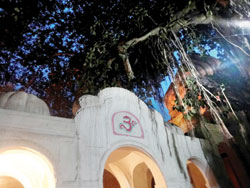
Gorak Nath Temple, at the Gor Khutree Archaeological Complex Peshawar, is now open for Hindu worshippers who regularly visit the site to pray.

The sun has just disappeared behind the mountains. Beneath the long hanging branches of the old banyan tree, a devotee is sweeping leaves to clean the floor for worshippers who are expected to arrive in a while.

Hundreds of birds above are chirping before settling down for the night. The fenced lawns outside are full, with noisy children running around and playing, the adolescent sauntering on the paved walkways, and their mothers gossiping.

These late evening visitors are usually from the nearby mohallahs who come here to escape power outages — and take refuge in the Gor Khutree Complex.

The colour palette for the sky is rapidly changing and the light tones of gold are turning into crimson, and violets merging with dark greys. Calls for evening prayers over loudspeakers lure males of all age groups to the mosque at the north-western corner of the Complex.

Gorak Nath Temple, at the Gor Khutree Archaeological Complex Peshawar, was built during the Sikh period around 1834 to 1849. Their Italian General, Paolo Avitabile, used the Complex as his residence. The temple is now open for Hindu worshippers who regularly visit the site to pray to their gods.
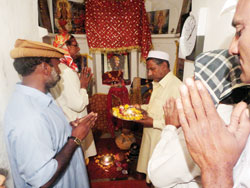
Just a few yards south, Kaka Ram, the seyvek, is giving final touches to the preparations in the Gorak Nath temple. Unlike the marbled floors and numerous fans at the mosque, his temple has earthen floor and a couple of helpers are connecting a power cable to the central building to light a few bulbs. Kaka Ram is waiting for the prayers at the mosque to finish, as some of his guests are Muslim, colleagues from his office at the secretariat, who will also attend Sheranwali Mata’s parshad tonight.

Six decades back, he was born in a humble little house adjacent to the temple. Many generations of his ancestors have served this temple before. His father died when he was seven. They were expelled from their ancestral house; his mother had fought back through courts. She won the temple back, in the year 2011, but their home at the compound is lost, almost forever, and she parted with life on the first day of last May.
According to Kaka Ram, more than 2000 people attended her funeral, the majority of who were Muslims. He recalls his childhood times, when the huge well under the banyan tree used to be frequented by parents with ailing children, both Hindu and Muslim,to receive ashnans, a sacrament that is believed to cleanse and protect its receivers from evil spells. His dealings and relationships with Muslim friends and neighbours are not tainted with biases or discriminations. They all celebrate Holis and Eids together and there is no purdah among their families, something reserved only for very close relatives in a traditional Peshawari society.

The Muslim guests have finished their prayers and are now waiting near the well for the ceremony to begin. Pundit Gokal has arrived from another temple to lead the prayers, and the number of worshippers is gradually increasing. The pundit is preparing a huge platter of fresh fruits at Mata’s mandir while the attendees are gathering in the arched aisle in the front. Following a few rituals, the congregation, with equal number of women, and quite a few children, started chanting the parshad.

The sky has turned deep blue and the banyan tree looks more imposing against it. The birds have gone almost silent. The visitors outside, in the lawns, are gradually thinning out and the peace of the night is gradually engulfing the compound, and the streets around it.

Originally published by The News on Sunday, 17 June 2012